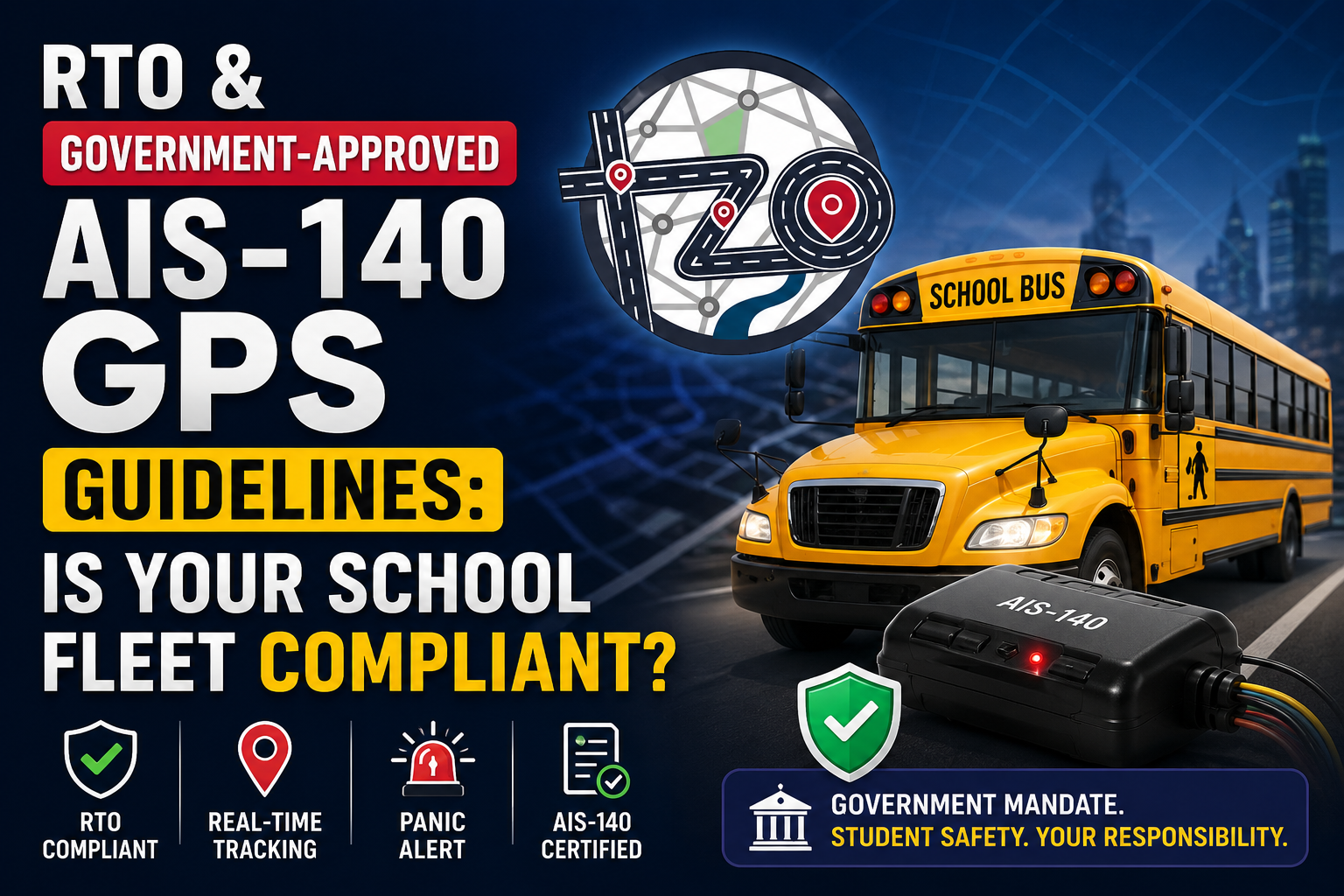
Operating passenger vehicles without verified tracking endpoints creates immediate, high-stakes exposure to registration pauses and failed vehicle fitness certificates. RTOs across India are no longer treating AIS-140 as a soft recommendation — it is a statutory requirement with real enforcement consequences.
Fortunately, aligning your fleet with a school fleet management dashboard software platform that supports verified AIS-140 hardware transforms a legal requirement into a genuine driver for student transit tracking system efficiency — protecting both students and operational budgets simultaneously.
Deconstructing the AIS-140 Government Mandate
The Intelligent Transportation System standard, known nationally as AIS-140, requires all public and institutional transport providers to deploy specialised tracking devices capable of secure, dual-server telemetry data streaming. These devices must feature dedicated SOS panic inputs to immediately safeguard passengers during sudden roadside emergencies. Four technical requirements define certification.
AIS-140 mandates that all tracking devices simultaneously stream location data to both the official government command centre database and the institution's private dashboard. This dual-link architecture guarantees constant transparency and cannot be replicated by standard GPS trackers.
Every certified vehicle must carry a hardwired emergency button accessible to the driver or attendant. When activated, an automated distress packet fires instantly to regional RTO monitoring portals — creating an official, timestamped incident record within seconds.
Signal dropout in dead zones is not acceptable for student-carrying vehicles. AIS-140-certified devices carry dual SIM cards so that when one cellular network loses coverage, the secondary channel maintains uninterrupted data transmission without any manual intervention.
Vehicle fitness renewals increasingly require documented AIS-140 hardware compliance. Schools operating non-certified equipment face immediate inspection failures, impound risks, and operational shutdowns — risks that a certified GPS deployment eliminates entirely.
Standard GPS vs. Certified AIS-140 Integration
The distinction between a standard GPS tracker and a certified AIS-140 device is not cosmetic. The technical and legal gap between them determines whether your school passes or fails an RTO fitness inspection — and whether you have any legal protection if an incident occurs on a route.
| Standard GPS Tracking Device | Certified AIS-140 Integration |
|---|---|
| Single-link streaming to private software only — no government portal connection | Dual SIM protocols broadcasting simultaneously to government portals and school dashboards |
| No dedicated physical emergency button — zero instant distress response capability | Mandatory panic hardwiring triggers instant regional control centre logs and location alerts |
| Triggers immediate vehicle compliance inspection failures at RTO fitness checks | Satisfies all legal parameters for swift transport permit renewals and fitness certificates |
| Single cellular network — signal dropout in dead zones breaks tracking entirely | Dual-SIM redundancy maintains uninterrupted data transmission across all coverage zones |
| No official incident record if an emergency occurs during a route | Every SOS event creates a timestamped, government-logged record for legal protection |
“True AIS-140 certification demands concurrent data streaming to both the official government command centre and the institution's private control screen. This double link guarantees constant transparency — and it cannot be replicated by a standard consumer GPS tracker.”
— Fleet Compliance Officer, South India Transport Authority
Protecting Budgets from Non-Compliance Penalties
Ignoring administrative transport regulations causes severe fiscal leaks. Failing local RTO evaluations results in immediate impound risks, heavy regulatory fines, and operational disruptions that can ground your entire fleet mid-term. The cost of non-compliance is not theoretical — it compounds rapidly.
RTO fitness failures: Vehicles without certified AIS-140 hardware fail fitness inspections immediately. A failed certificate means the bus cannot legally operate until the violation is remedied — disrupting student transport entirely.
Regulatory fines: RTOs are empowered to levy compounding financial penalties for continued operation of non-compliant commercial vehicles. These fines escalate with each inspection cycle.
Legal liability exposure: If an incident occurs on a route and the vehicle lacks a certified SOS system and government data trail, the school bears full liability — with no timestamped record to demonstrate any proactive duty of care.
Modern Software Integration: Compliance Without Complexity
Deploying regulatory hardware does not force schools to tolerate outdated, fragmented database interfaces. Leading enterprise platform designs cleanly bridge strict AIS-140 telemetry pipelines directly into accessible, unified school management environments.
A well-integrated platform feeds government-mandated telemetry and parent-facing location updates through a single software layer. Schools evaluate their total school bus tracking software ROI by combining strict government safety compliance with automated parent notifications in one unified interface — no duplicate systems, no duplicate costs.
Transport managers gain a live dashboard covering every active bus, compliance status, route deviation, and SOS event in real time. The fragmented picture of radio check-ins and manual logs is replaced by a single, reliable source of operational truth — one that satisfies both administrative and regulatory requirements simultaneously.
Every SOS activation, route deviation, or geofence breach is automatically logged with GPS coordinates and timestamps. This creates an unalterable, government-readable record that demonstrates active duty of care — a critical asset if a parent query or regulatory review arises.
Five Steps to Achieve Full AIS-140 Compliance
Audit every bus in your fleet against AIS-140 hardware certification documentation
Confirm your GPS provider streams to both government servers and your private dashboard simultaneously
Verify physical SOS panic button is hardwired and connected to RTO monitoring portals
Ensure dual-SIM capability is active and tested across your primary route corridors
Integrate certified telemetry feeds into your school fleet management dashboard for unified visibility
Frequently Asked Questions
Is your fleet fully AIS-140 compliant?
A brief infrastructure audit identifies any compliance gaps before your next RTO fitness inspection — and shows exactly how MyTripzo closes them without disrupting your current operations.
Book a Fleet Compliance Audit