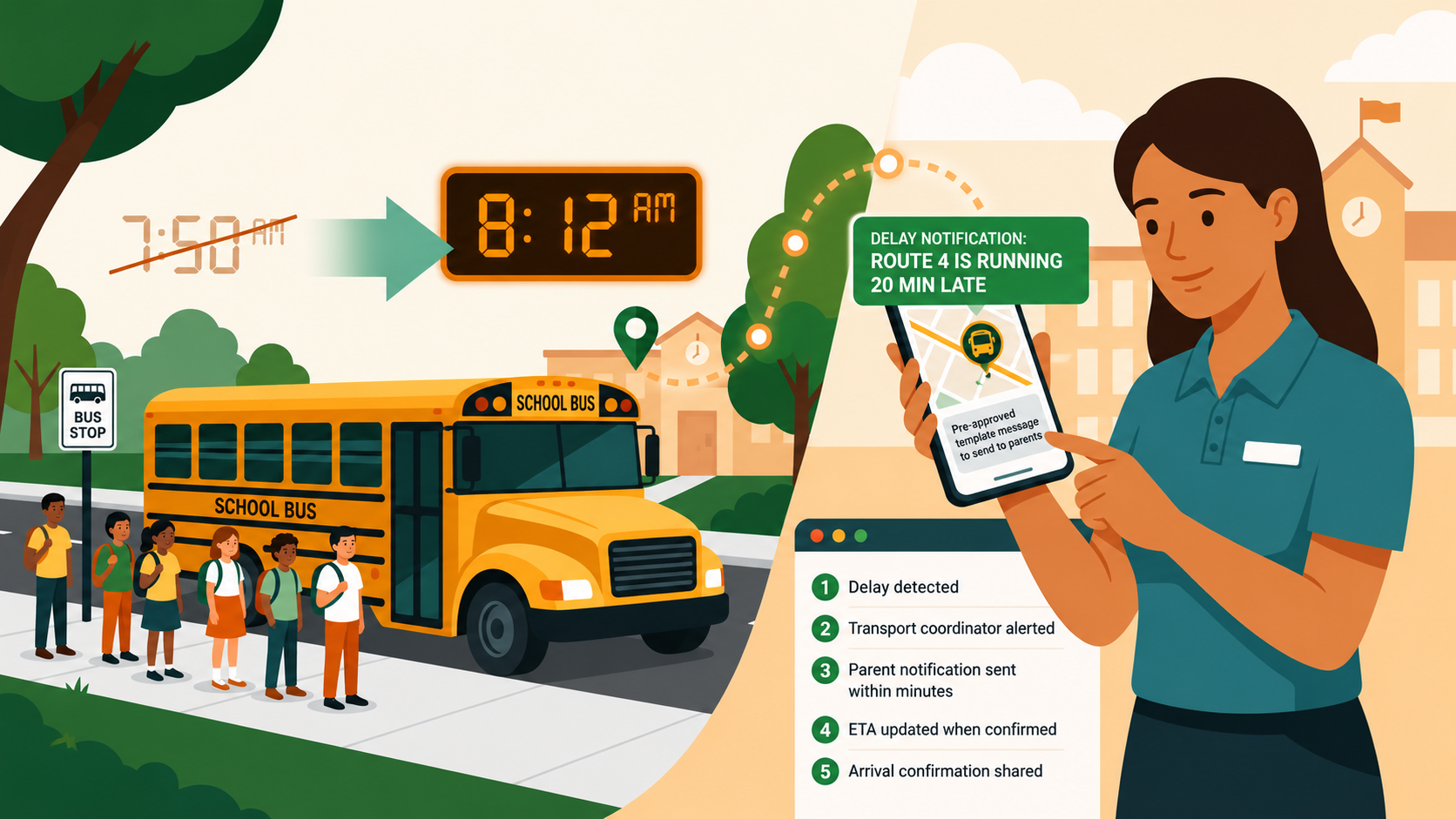
It's 8:12 AM. The school bus was due at 7:50. A parent's phone is already in hand — not to call the school, but to post in the class WhatsApp group. Within minutes, 30 parents are messaging each other.
Meanwhile, the school office has no idea the bus is delayed because no one told them either.
Sound familiar? This is not a technology problem. It's a protocol problem — and it plays out in schools across the country every single week.
5 min
Ideal window to send the first parent notification after a delay is detected
3×
More inbound calls received when parents get no proactive update from the school
1 msg
A single clear update reduces parent anxiety more than multiple vague follow-ups
Why the Current System Breaks Down
Before building a solution, it helps to name the real problems. Most schools aren't dealing with one big failure — they're dealing with three small gaps that compound each other.
📞Inbound call overload
When parents don't hear anything, they call. Thirty calls in ten minutes ties up your office staff and still doesn't resolve the issue.
❓No clear accountability
Who's responsible for the first call? The driver? The transport coordinator? The principal's office? If it's unclear, it doesn't happen.
🕐Manual tracking lag
When bus location is tracked via driver calls or manual check-ins, information is always delayed — and sometimes just wrong.
“The parent shouldn't be the one discovering the bus is late. The school should already know — and should have already told them.”
The result isn't just a bad morning. It's a slow erosion of trust. Parents don't mind delays — they mind silence. When they feel like they're the last to know, they stop trusting the school's transport system entirely.
So — Who Should Have Called First?
The short answer: the system should have.
A well-designed delay communication protocol isn't about a human making a judgment call at 7:55 AM. It's about a defined trigger — a bus that hasn't checked in, a GPS flag, a driver report — automatically setting a chain of actions in motion.
In the absence of an automated system, the answer is your transport coordinator, within the first 5 minutes of a confirmed or suspected delay. Not after they've tried to reach the driver. Not after they've figured out why. Parents need a heads-up even if the full picture isn't clear yet.
A Step-by-Step Delay Response Protocol
This protocol works whether you're using bus tracking software or managing things manually. The goal is simple: parents should hear from the school before they start calling the school.

Bus Delay Communication Protocol — School Transport
1
T+0 min
Delay detected
Bus misses check-in window, GPS shows stall, or driver reports an issue. This is the trigger — not "let's wait and see."
GPS / App alert2
T+1 min
Transport coordinator is notified
The transport coordinator receives an automated alert or a direct call from the driver. One person owns the situation from here.
App notification3
T+5 min
First parent notification sent
A pre-approved message goes out via SMS and push: "Bus Route 4 is running approximately 15–20 minutes late. We'll update you shortly." Even a partial estimate is better than silence.
SMS + Push4
T+5–10 min
Root cause assessment
Coordinator contacts the driver, checks live GPS, and determines ETA. This runs in parallel with parent communication — not before it.
Internal step5
T+10–15 min
Updated ETA communicated
A second message goes out with a revised arrival time or a brief reason for the delay if known. Keep it calm, factual, and specific.
SMS + Push6
T+arrival
All-clear sent when bus arrives
A brief confirmation: "Bus Route 4 has arrived. All students on board." This closes the loop and reinforces trust for next time.
App notificationNotice what this protocol does not include: any moment where a parent has to wonder, wait, or call the school to find out what's happening.
Staff Quick-Reference Checklist
Print this and post it near the transport coordinator's desk. On a delay morning, this is the only document that needs to exist.
Delay Morning Checklist — Transport Coordinator
Delay confirmed— GPS flag, driver call, or missed check-in. Note the time. Send parent notification #1 within 5 minutes — even if ETA is unknown. Use pre-approved template. Contact the driver— get current location, reason for delay, and best estimate for arrival. Notify the front office— so reception can redirect any inbound calls and is not caught off-guard. Send updated ETA notification once confirmed — specific time preferred over vague estimate. Log the delay— time detected, reason, notifications sent. Useful for patterns and accountability. Send all-clear when bus arrives— confirm students are safe and on board. Debrief if needed— was this a one-off? Does the route or schedule need a review?
What Parents Actually Need: Trust, Not Just Updates
Here's a truth that gets overlooked in most transport conversations: parents can handle a late bus. What they cannot handle is feeling ignored.
A single well-timed message — “Bus Route 4 is running late, we're on it” — does more to build parent trust than a perfect on-time record followed by one silent, unexplained 25-minute delay.
Proactive communication signals that the school is in control, that student safety is monitored, and that parents are partners — not afterthoughts. That's the difference between a school that manages transport and one that earns loyalty for it.
The communication channels matter too. SMS and app push notifications outperform email for time-sensitive situations. Parents are on their phones during the school run — your message needs to meet them there, not wait in an inbox.
Start Before the Next Delay Happens
The worst time to design your communication protocol is at 7:55 AM when a bus is already missing. Build the process now — assign ownership, draft your notification templates, and decide your trigger thresholds — so that the next delay is handled before the first parent picks up the phone.
The question was never whether to communicate. It was always about who acts first. Make sure it's your school.
Frequently Asked Questions
What if the delay reason isn't known yet — should we still notify parents?
Yes, immediately. The first notification doesn't need to explain the cause — it just needs to confirm that the school knows and is on it. "Bus Route 4 is running approximately 15–20 minutes late — we'll update you shortly" is all parents need to hear in the first 5 minutes. Uncertainty is tolerable. Silence is not.
Who should own the delay protocol in our school?
One person. Ambiguity about ownership is the most common reason delay protocols break down. Designate your transport coordinator as the single accountable role. If they're unavailable, there should be a named backup — not "the front office" in general. A specific name, on a printed checklist, posted at the transport coordinator's desk.
What's the best channel to reach parents during a delay?
SMS and app push notifications significantly outperform email for time-sensitive situations. Parents are on their phones during the school run — your message needs to reach them there, not wait in an inbox they'll check at 10am. If you use an app like MyTripzo, push + SMS together gives you the best coverage, including for parents without smartphones.
How do we handle repeat delays on the same route?
Log every delay with time detected, cause, and notifications sent. After 3+ delays on the same route in a month, review the root cause: Is the pick-up window too tight? Is the route over-scheduled? Are there recurring traffic patterns? The delay log is not just a compliance record — it's your early warning system for structural route problems.
See how MyTripzo automates every step of this protocol
Real-time GPS tracking, automated parent alerts via SMS and app, and delay logs — all in one platform built for school transport teams.
Book a Free DemoNo commitment. 20-minute walkthrough. See it live.