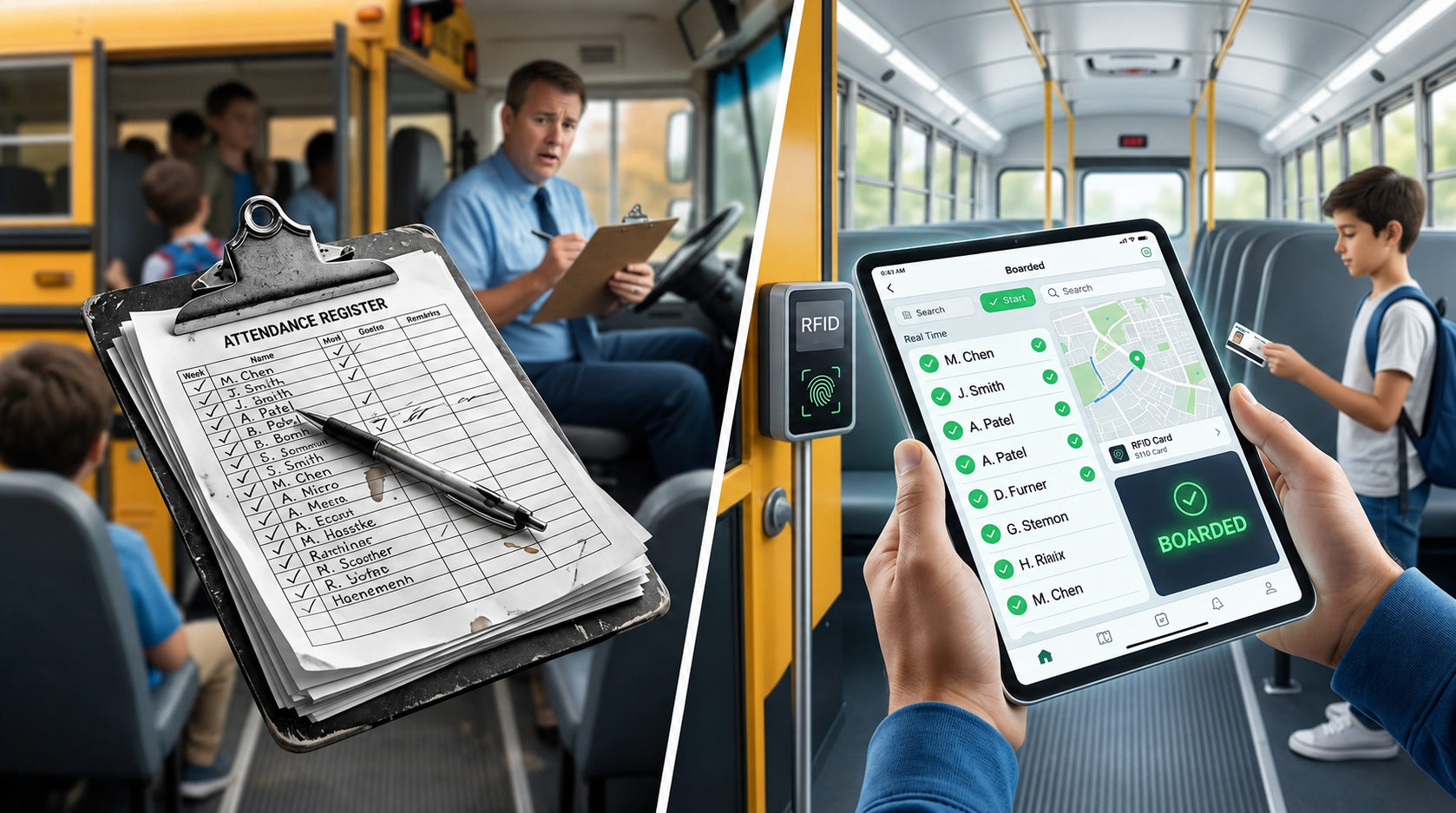
Most schools manage the transport transition through experience, trust, and manual paper registers. These systems are often run by genuinely dedicated staff. But they harbour quiet liabilities — small, everyday gaps in information that accumulate unnoticed until a specific moment makes them visible.
Moving from manual registers to digital attendance on school buses isn't simply about upgrading technology. It's about closing those gaps to build a culture of proactive, documented care — for students, for families, and for the institution.
The Limitations of Paper in a Dynamic Environment
In a controlled classroom, a paper register works reasonably well. But student transportation is dynamic — buses deal with traffic, weather, last-minute schedule changes, and the reality that a driver managing 30 children cannot also manage a flawless paper audit trail. Relying on manual logs in this environment introduces three primary risks.
If a child misses the bus, that information typically moves through a slow chain of manual phone calls — if it moves at all before the parent calls in a panic. Digital systems automate this instantly: parents are notified the second a child boards or fails to board, with no manual step required from school staff.
Statistics show that 40% of transport-related calls to school offices are parents simply asking for the bus's current location. Manual systems require a staff member to call the driver — distracting, time-consuming, and occasionally impossible if the driver is focused on the road. A live GPS bus tracking app eliminates this category of call entirely.
In the event of any query, governance review, or parental concern, the central question is always: what did the school know, and when? Manual registers provide a retrospective snapshot at best. Digital records provide timestamped, unalterable evidence of systematic care — a meaningful distinction when it matters most.
Beyond Tracking: What Digital Attendance Actually Provides
For principals and transport managers, the shift to a digital transport management system provides a single source of truth that paper simply cannot match. The benefits flow in two directions simultaneously: inward toward operational clarity, and outward toward the families whose trust you depend on.
Operational clarity: A centralised dashboard lets managers see every active bus, delay, and route status in real time — replacing fragmented phone calls with one reliable view.
Staff efficiency: Proactive notifications significantly reduce inbound calls, freeing office staff for more meaningful work during peak pickup windows.
Route optimisation: Digital trip data gives schools the evidence to refine routes over time — reducing fuel costs and cutting journey times without adding headcount.
Immediate reassurance: Parents receive quiet alerts when their child boards and as the bus approaches home. A simple notification that removes the daily uncertainty entirely.
Increased trust: 68% of parents report that real-time boarding notifications would significantly improve their confidence in school transport. That confidence, consistently delivered, turns parents into genuine advocates for your school.
“Moving from paper to digital didn't add work — it removed it. We went from fielding eight calls every afternoon to fielding one or two. That time went back to our students.”
— Transport Manager, South India
The Five Capabilities That Change the Picture
A modern school bus tracking system delivers more than a GPS dot on a map. These are the five capabilities that make a measurable difference from day one.
Operational Clarity for Admins
A centralised dashboard lets transport managers see every active bus, delay, and route status in real time — replacing fragmented phone calls with a single, reliable source of truth.
Automated Parent Notifications
Parents receive a quiet alert the moment their child boards and another as the bus approaches home. No calls needed — reassurance delivered consistently, every single day.
Timestamped Boarding Records
Every boarding and drop-off is logged automatically with accurate timestamps, replacing error-prone paper registers with an unalterable digital record available instantly on request.
Route Optimisation Data
Over time, digital trip data gives schools the evidence to refine routes — reducing fuel costs, shortening journey times, and improving punctuality without adding staff.
Audit-Ready Trip Logs
Every journey is stored with complete location history. In the event of any parental query, governance review, or compliance requirement, schools can respond clearly and immediately.
Manual vs. Digital: A Direct Comparison
The case for paperless school transport logs becomes clear when you set the two approaches side by side. These aren't theoretical outcomes — they're the practical differences schools report within their first term of using a digital system.
Making the Transition: Where Schools Begin
For schools considering this change, the transition to digital transport management is not a disruptive overhaul. Systems are typically up and running within a single day, with hardware managed externally and software as intuitive as a standard messaging app. The practical starting point almost always comes down to five steps.
- ✓Replace paper registers with digital boarding confirmation on every route
- ✓Enable automatic parent notifications for boarding and drop-off events
- ✓Give transport managers a live dashboard covering all active buses
- ✓Set up a structured alert protocol for delays and route changes
- ✓Build a searchable trip log for every journey — accessible to authorised staff instantly
None of these steps require significant staff time to set up. The difference that families notice — a simple notification that their child has boarded safely — tends to be felt within the first week. The internal operational gains, from reduced call volume to cleaner records, are felt from day one.
Ready to close the safety gap at your school?
We work with schools of all sizes to replace paper registers with a digital attendance system that works from day one. A short conversation is all it takes to see what's possible for your fleet.
Book a Free Demo →