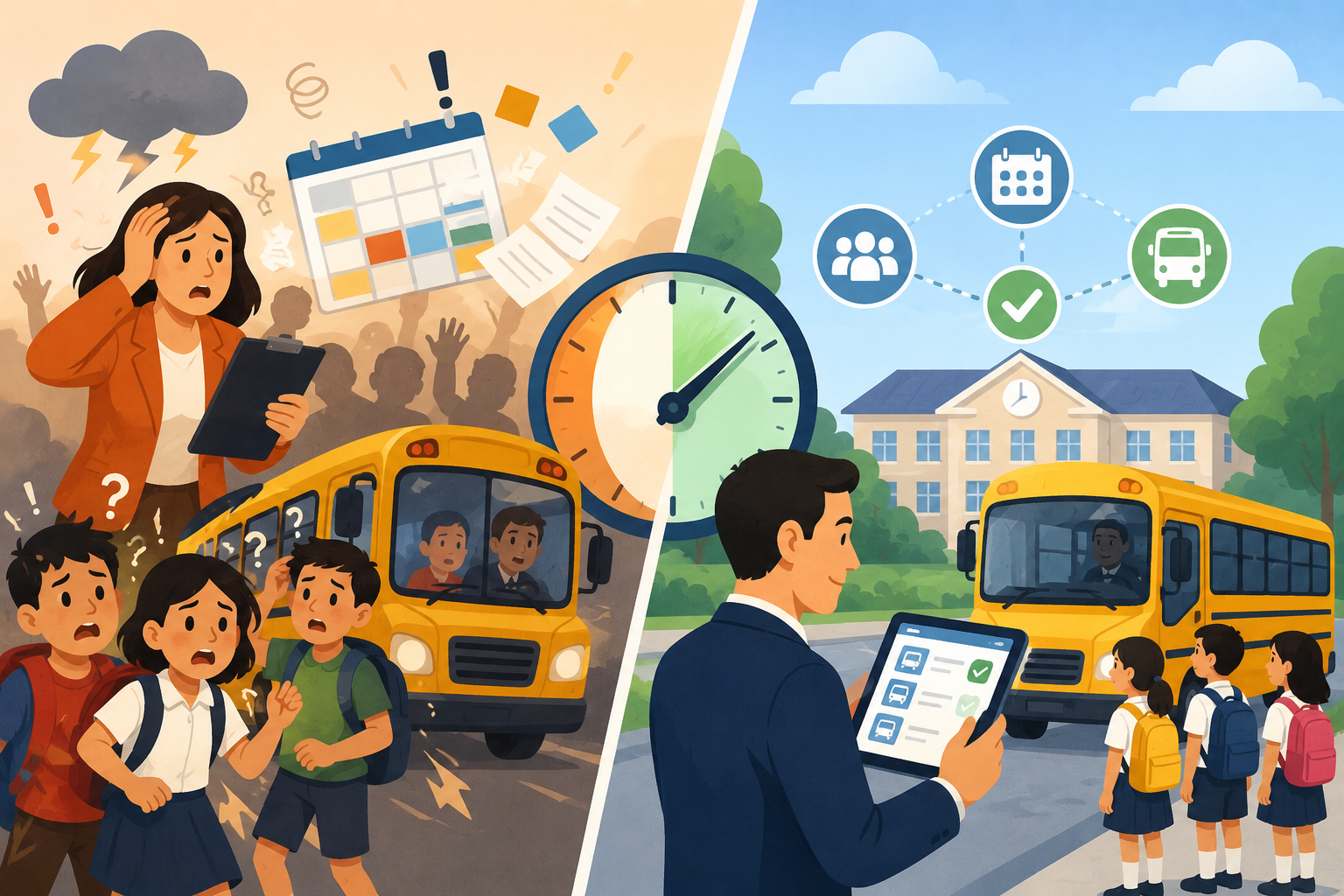
End-of-term should feel like a finish line. Instead, for most school transport teams, it feels like the hardest operational day of the entire year. Half-day schedules that weren't communicated to drivers. Grade 6 leaving at noon while Grade 9 leaves at 2. Parents queuing at Gate B when buses are loading at Gate A. And somewhere in the middle of all of it, a transport coordinator on their sixth phone call of the hour trying to hold it together.
This doesn't have to be the story. The chaos of last-day transport isn't inevitable — it's the result of a system that wasn't designed for non-standard days. Smart scheduling changes the equation entirely, and this term-end is soon enough to start.
The Five Chaos Triggers — And Why They All Compound
End-of-term transport breakdowns rarely come from one thing going wrong. They come from five things going slightly wrong at exactly the same time.
Standard routes built for 3:30 PM don't map cleanly to 12:00 PM departures. Timing gaps leave students waiting and parents panicking.
Different year groups dismissing at different times means multiple concurrent boarding windows — a coordination nightmare on a single fleet.
When pickup points change for event days and the update never reaches parents, the result is congestion, confusion, and avoidable complaints.
A schedule change communicated by WhatsApp at 9 AM on the day — to a driver who's already on the road — is not a communication. It's a wish.
Sports days, prize-givings, and field trips create routes that didn't exist the week before. Adding them manually, under pressure, is where errors multiply.
What makes these five triggers genuinely dangerous is how they interact. A staggered dismissal creates multiple concurrent boarding windows. Multiple boarding windows confuse drivers who haven't been updated. Confused drivers create delays that parents notice at the wrong gate. By the time the first complaint call hits the office, four things have already gone wrong simultaneously.
“End-of-term chaos isn't a people problem. It's a system problem — and systems can be fixed.”
What Smart Scheduling Actually Looks Like
Smart scheduling isn't about more meetings or more spreadsheet tabs. It's about a transport system that can handle non-standard days as confidently as it handles standard ones — because the tools are built for both.
When a schedule change is entered into the system, it doesn't wait for someone to remember to text the driver or update the school app. It pushes automatically to every affected stakeholder the moment the change is saved. No chain of phone calls. No missed updates.
AutomatedGrade-staggered dismissals can be built directly into the transport schedule — Grade 6 at 12:00, Grade 9 at 14:00, buses assigned accordingly. The system manages the sequencing so your coordinator doesn't have to hold it in their head. Each slot runs independently, with its own boarding confirmations and parent alerts.
FlexibleSports day, annual prize-giving, end-of-year trip — each of these can be set up as a temporary route in advance, assigned to available buses, and then archived cleanly afterwards. No permanent clutter in your route list, no last-minute improvisation on the day.
On-DemandOn a normal day, a delayed bus is a minor inconvenience. On a half-day with parents leaving work early and students outside the school gates, a delayed bus is a crisis. Real-time GPS during non-standard dismissal hours gives your team visibility when it matters most — and gives parents the one thing that prevents panic calls: information.
Live TrackingWhen a gate changes, a time changes, or a bus is reassigned, parents find out through the app — not through the class WhatsApp group three hours later. The communication layer isn't separate from the scheduling layer. They're the same system, triggered by the same action.
Real-TimeHow the Same Day Looks — With and Without Smart Scheduling
The difference isn't subtle. It's the difference between a day you dread and a day that actually works.
This Term-End Is the Right Time to Start
There's a temptation to treat end-of-term as a known chaos event — something to survive rather than solve. That framing costs your school more than the half-day itself. It costs your transport coordinator their bandwidth. It costs parents their confidence. And it costs your leadership team the hours spent on avoidable complaints rather than genuine planning.
The schools that run calm last days aren't the ones with better luck or more staff. They're the ones that built a system capable of handling the day before it arrived. Smart scheduling is not a luxury for large schools. It's the minimum standard for any school that takes transport seriously.
The next term-end is already on the calendar. The question is whether your transport system is ready for it — or whether you're planning to improvise again.
Frequently Asked Questions
Don't let the last day of term write itself
MyTripzo handles multi-time-slot dismissals, temporary event routes, automated driver updates, and real-time parent notifications — all from one dashboard. Book a demo before your next term-end and see exactly how it handles non-standard days.
Book a Tripzo Demo30-minute walkthrough · Bring your transport coordinator · No commitment