73%
of parents say they feel anxious about their child's school commute — yet fewer than 1 in 3 have ever formally asked their school about transport safety procedures. You're not alone in worrying. But you can do something about it.
A note before you read onAsking your school about bus safety isn't being difficult — it's being a responsible parent. Every school should welcome these questions. And if they don't have good answers yet, your asking might be exactly what prompts them to find better ones.
School buses carry the most precious cargo imaginable. And yet, most parents hand their children over each morning without knowing some pretty fundamental things — not because they don't care, but because no one told them these questions even existed.
These five questions are simple, direct, and completely reasonable to ask. Print them out, share them with your PTA group, or bring them to your next parent-teacher meeting. They're yours to use.
The 5 Questions
1
"Can I see where my child's bus is — right now, in real time?"
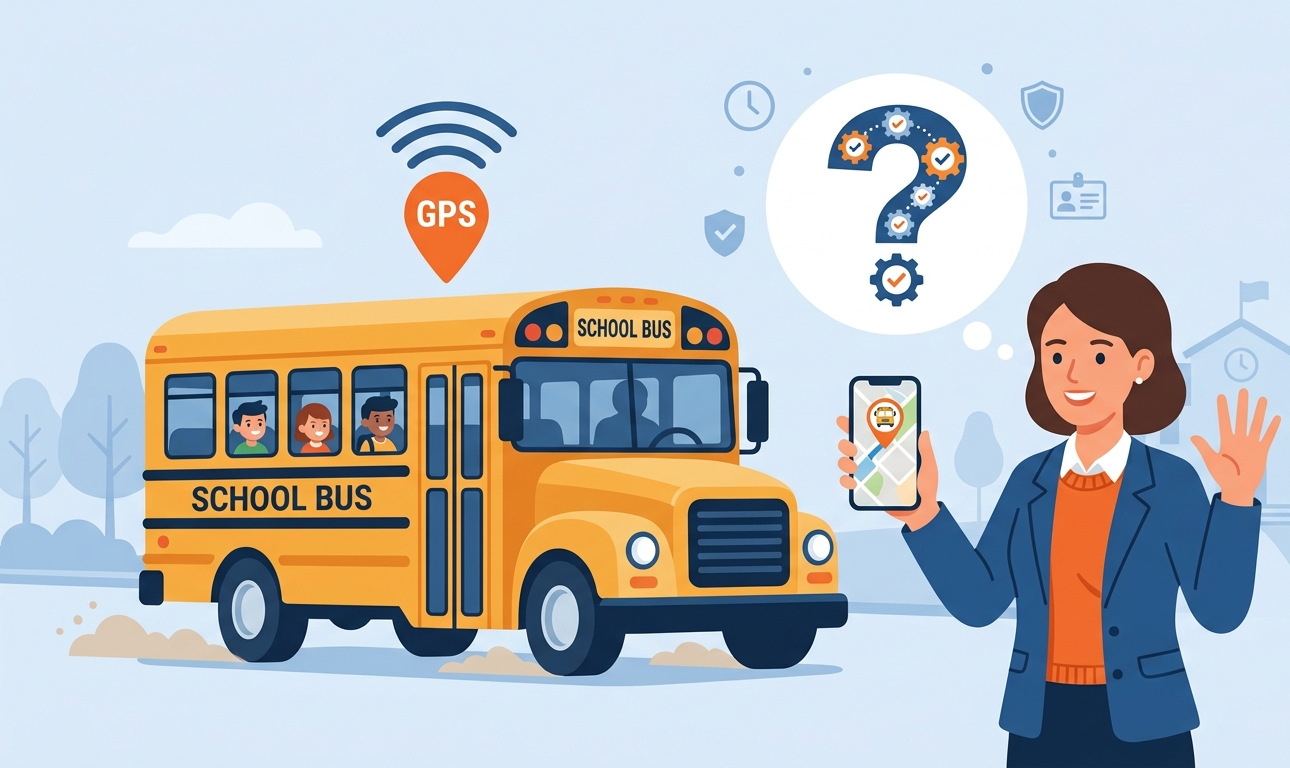
GPS TrackingLive GPS tracking has become a standard expectation in school transport — not a luxury. When your child is on a bus, you should be able to open an app and see exactly where that bus is, without calling the school or waiting for a driver to pick up.
Schools that use a bus tracking platform can give parents access to real-time location updates. This single capability reduces parent anxiety, eliminates uncertainty during delays, and creates a layer of accountability that benefits everyone — students, drivers, and school staff alike.
If the school's answer is "we don't have that yet," that's useful information. It tells you where the gap is — and gives you something specific to advocate for.
A good answer looks like
Parents receive live GPS access through a dedicated app. Delays trigger automatic notifications. A transport coordinator monitors all buses from a central dashboard.
Watch out for
Vague responses like "the driver calls us if there's an issue" suggest the school is relying on reactive communication rather than real-time visibility.
2
"How do I know my child actually got on — and off — the right bus?"
Boarding & Drop-offThis question makes many parents uncomfortable to ask — because it implies the possibility that something could go wrong. But that discomfort is exactly why it needs to be asked.
Student boarding and drop-off confirmation is one of the most critical safety measures a school can have. It means the school has a verified record — not just a driver's word — of which students boarded at which stop, and which students were dropped off safely at the end of the route.
Modern transport systems can send parents a notification the moment their child boards the bus in the morning, and again when they're dropped off. Ask your school whether this is in place — and if not, whether it's something they're working towards.
A good answer looks like
Automated boarding and drop-off alerts are sent to parents in real time. The school's dashboard shows a verified record of every student's journey status.
Watch out for
If the school says attendance is "taken manually on paper," ask how errors are caught — and how quickly a missed boarding would be noticed.
3
"Who do I call if there's an emergency — and how quickly will someone respond?"
Emergency ProtocolEvery school transport operation should have a clearly documented emergency response protocol. Not a general sense that "someone will handle it" — but a specific, tested process that staff know and parents can access.
Ask your school: Is there a dedicated transport emergency number? What happens if a bus breaks down mid-route? What's the procedure if a child doesn't arrive at school? Who is notified first, and within what timeframe?
A school with good safety infrastructure will answer these questions confidently and specifically. If the response is vague or improvised-sounding, that's a signal the protocol needs strengthening — and parent pressure is often what accelerates that conversation.
A good answer looks like
A named transport coordinator with a direct number. Documented procedures for breakdowns, late arrivals, and unboarded students. Tested response times shared with parents.
Watch out for
"Call the main office" is not an emergency protocol. If there's no dedicated escalation path, there's no real plan.
4
"Has every driver been background-checked — and is their licence current?"
Driver SafetyThis is perhaps the most direct question on this list — and the one parents are most hesitant to ask because it can feel confrontational. It isn't. It's essential.
Every driver transporting children should have undergone a formal background verification process and hold a valid, appropriate driving licence. This should be documented and periodically reviewed — not a one-time check done years ago and never revisited.
Ask your school: What is the vetting process for transport staff? How often are driver records reviewed? Is there a named person responsible for maintaining these records? Schools with a robust transport policy will have clear, reassuring answers to all three.
A good answer looks like
Background verification completed before onboarding. Licence validity reviewed at least annually. A transport manager owns the record for every driver in the fleet.
Watch out for
"We trust our drivers" is a character reference, not a verification process. Documentation is what makes trust verifiable.
5
"How often are the buses inspected — and where can I see those records?"
Bus MaintenanceThe condition of the vehicle your child travels in every day matters — and it's completely reasonable to ask about it. Bus maintenance isn't just a legal requirement; it's a basic duty of care.
Ask your school: What is the maintenance schedule for each bus in the fleet? Are pre-trip safety checks conducted daily? Is there a log of inspections that can be shared with parents on request?
You don't need to see every technical detail — but knowing that a documented process exists, and that someone is accountable for it, gives you a meaningful level of assurance that your child is travelling in a roadworthy vehicle.
A good answer looks like
A written maintenance schedule with named accountability. Daily pre-trip checks logged digitally. Records available to parents on reasonable request.
Watch out for
If the school cannot name who is responsible for maintenance oversight, that gap in accountability is itself a concern.
What to Do With the Answers
“A school that welcomes these questions isn't just being polite. It's showing you that safety is something they've actually thought about.”
✅
Got excellent answers to all fiveYou can feel genuinely reassured — and tell other parents. Schools that have thought carefully about these questions usually have the systems to back it up.
📋
Got some strong answers and some gapsThis is the most common outcome. Note which areas are weak and raise them specifically at your next PTA meeting or in a written follow-up. Targeted questions get better responses than general concerns.
📢
Found that key systems aren't in placeShare this guide with other parents. Collective parent enquiry is the most effective lever for change. When a group asks the same questions, schools move faster than when a single parent does.
Share this post with other parents. Bring these questions to your next school meeting. You're not raising concerns — you're raising standards.
Already ahead of the curveSome schools are already using platforms like MyTripzo that give parents real-time visibility, boarding confirmations, and instant delay notifications. If your school isn't there yet, it's worth asking them why not — and pointing them here.
Frequently Asked Questions
Is it appropriate for parents to ask schools these kinds of questions?+
Absolutely — and any school with a strong transport safety culture will welcome them. These are not confrontational demands; they're reasonable enquiries about the systems that keep your child safe every day. Schools that respond defensively or with vague answers are, indirectly, telling you something important about how seriously they take transport safety. Most transport coordinators are glad to have these conversations — they help identify gaps and build the case for better systems with school leadership.
What if my school doesn't have good answers to these questions?+
Don't treat this as a reason to panic — treat it as a call to action. Start by raising the issue through the PTA or a formal letter to the principal. Ask that a transport safety review be placed on the agenda for the next governing body meeting. When multiple parents ask the same questions, schools respond. It's also worth sharing resources like this guide — sometimes school leadership simply isn't aware of what's possible with modern transport management software, and a parent pointing to specific solutions is far more persuasive than a general complaint.
How does real-time GPS tracking actually work for parents?+
A school bus tracking platform like MyTripzo installs a GPS device on each bus in the fleet and connects it to a cloud dashboard. Parents receive access via a dedicated app — either a web link or a downloadable application. When the bus is active, parents can see its live location on a map, updated every 30–60 seconds. Notifications are triggered automatically when the bus is approaching their child's stop, when the child boards, and when they are dropped off. The parent never has to call the school or the driver — the information comes to them.
How can I raise bus safety concerns without coming across as difficult?+
Frame your questions as collaboration rather than criticism. "We'd love to understand more about how transport safety is managed" lands very differently from "I'm worried the school isn't doing enough." Share this guide with your PTA group and let the questions come collectively rather than from a single parent. You can also approach it constructively: "I came across a checklist of questions that schools with great transport systems are usually able to answer — I'd love to go through these together." Schools respond best when parents are specific, solution-oriented, and working with them rather than against them.
Does Your School Have the Answers?
MyTripzo gives schools the tools to answer every one of these questions confidently — real-time GPS, boarding alerts, driver records, and parent notifications, all in one platform.
Book a Free Demo →Forward this to your school's transport coordinator or principal