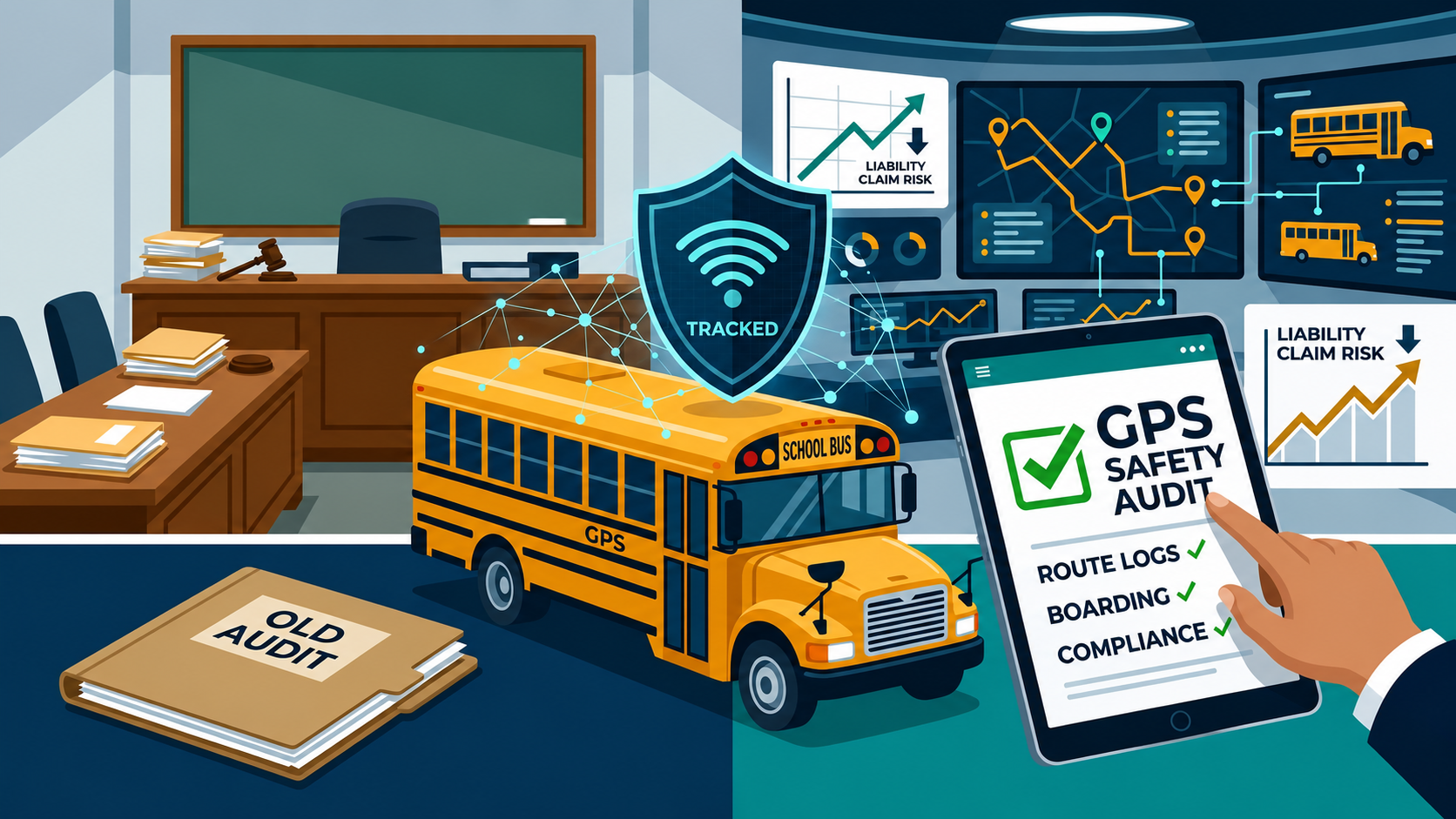
Five years ago, that question would have been answered with a maintenance log and a driver licence file. Today, auditors, insurers, and regulators are asking something more specific: do you have a GPS-tracked, timestamped record of where your buses were, who was on them, and when?
This shift didn't happen overnight. It's the result of a convergence — tightening safeguarding expectations, rising transport-related liability claims, and a growing consensus among progressive school boards that untracked fleets represent a governance gap that no institution can afford to leave unaddressed.
Six Governance Dimensions — All Pointing in the Same Direction
GPS tracking in school transport isn't a technology conversation. It's a governance conversation. And it touches six distinct areas of institutional accountability.
A school's duty of care extends to the journey, not just the campus. Boards without documented transport oversight are increasingly exposed when incidents are litigated.
When something goes wrong, the first question isn't "what happened" — it's "what do you have on record?" GPS logs, boarding confirmations, and route timestamps are the difference between a documented response and a gap.
Insurers are beginning to factor fleet tracking into premium calculations and coverage terms. Untracked fleets are higher-risk profiles — and boards that haven't addressed this may face increasing premium exposure.
When a transport incident becomes public, the board's response is scrutinised. Schools with documented safety systems are positioned to respond with evidence. Those without face questions they cannot answer.
Transport safety regulations in multiple jurisdictions are moving toward mandatory tracking requirements for student transport. Forward-thinking boards are implementing now rather than scrambling when compliance becomes compulsory.
Safeguarding frameworks increasingly require schools to evidence oversight of student welfare beyond school grounds. Transport is an unsupervised environment — and regulators are asking how boards are monitoring it.
“The boards asking about GPS tracking today are not being cautious. They are being current.”
What Auditors Are Now Specifically Asking
Transport-related questions have moved from a footnote in the vehicle maintenance section to a dedicated line of enquiry. Here is what progressive auditors — and increasingly, school inspectors — are now asking directly.
A board that can answer these questions with confidence — with documented evidence rather than general assurance — is a board that has genuinely discharged its transport governance obligations. A board that cannot is carrying risk it may not have fully quantified.
Compliant vs. Non-Compliant: What the Records Actually Look Like
The gap between a school that passes a transport safety audit and one that struggles isn't usually intent. It's documentation. Here is what that difference looks like in practice.
How GPS Data Functions as Governance Evidence
A timestamped GPS record creates a verified, retrievable account of every journey: the route taken, the speed at which each segment was travelled, the duration of stops, and the time of arrival at each destination. When combined with boarding confirmation data, it answers — with documented precision — who was on the bus, where they boarded, and where they alighted.
In an incident review, this is not background information. It is the primary evidence. It determines whether a driver deviated from an approved route. It confirms whether a student was on board at the time of an incident. It establishes the sequence of events with a level of accuracy that no human recollection can match and no paper register can replicate.
Boards that understand this are not implementing GPS tracking because it is fashionable. They are implementing it because they understand what governance accountability actually requires when something goes wrong.
A visible trend among progressive school boards globally: transport safety has been elevated from an operational matter delegated entirely to staff, to a board-level governance item reviewed formally at least once per year. The boards making this shift are doing so in response to audit findings, insurance conversations, and — in some cases — transport incidents at peer institutions that made the stakes concrete.
What Trustees Should Be Asking Right Now
If your board has not formally discussed transport safety in the last twelve months, the starting point is not a technology procurement decision. It is a governance conversation.
Ask your principal or transport coordinator: can we produce a complete GPS log and boarding record for any bus journey in the last 90 days within one hour of being asked? If the answer is uncertain, the gap is real — and it is addressable.
Transport governance is not a compliance box to be ticked once and filed. It is an ongoing institutional commitment — one that progressive boards are now building into their annual safety audit framework as a matter of course. The question for every trustee is not whether this applies to your school. It is whether your school is ready to demonstrate it.
Frequently Asked Questions
Is your transport team audit-ready?
MyTripzo gives school boards the GPS logs, boarding records, parent notification trails, and route history that auditors, insurers, and regulators are now asking for — all in one compliance-ready platform.
Book a MyTripzo Demo