For most transport managers, the honest answer is uncomfortable. It involves a spreadsheet, three WhatsApp threads, at least one unanswered driver call, and a gut feeling that something might be running late — but there's no way to confirm it yet.
This is not a staffing problem. It's a visibility problem. And visibility problems don't get better by adding people — they get better by fixing the system.
The Real Cost of Running Blind
Schools with 15, 20, or 30 buses aren't just managing routes. They're managing accountability — to parents, to school leadership, to safety standards that have no margin for error. When the tools don't match the responsibility, something gives. Usually it's your transport team's bandwidth.
No single view means constant tab-switching. Information lives in five places and is current in none of them.
You find out about problems when parents call — not when buses deviate, stall, or run behind.
Manual coordination at scale is exhausting. Your team spends more time chasing status than managing outcomes.
Fleet grows. Expectations grow. Headcount doesn't — and neither can it. The math only works with better systems.
The problem compounds over time. A team stretched thin by manual processes becomes slower to respond, slower to communicate, and more prone to the kind of gaps that erode parent trust and put school leadership on the defensive.
“You don't need more people watching the fleet. You need one system that watches it for you.”
What a Unified Dashboard Actually Does
The phrase “transport dashboard” gets used loosely. So let's be specific about what it means in practice — and what capabilities genuinely move the needle for a school managing 15 to 30 buses.
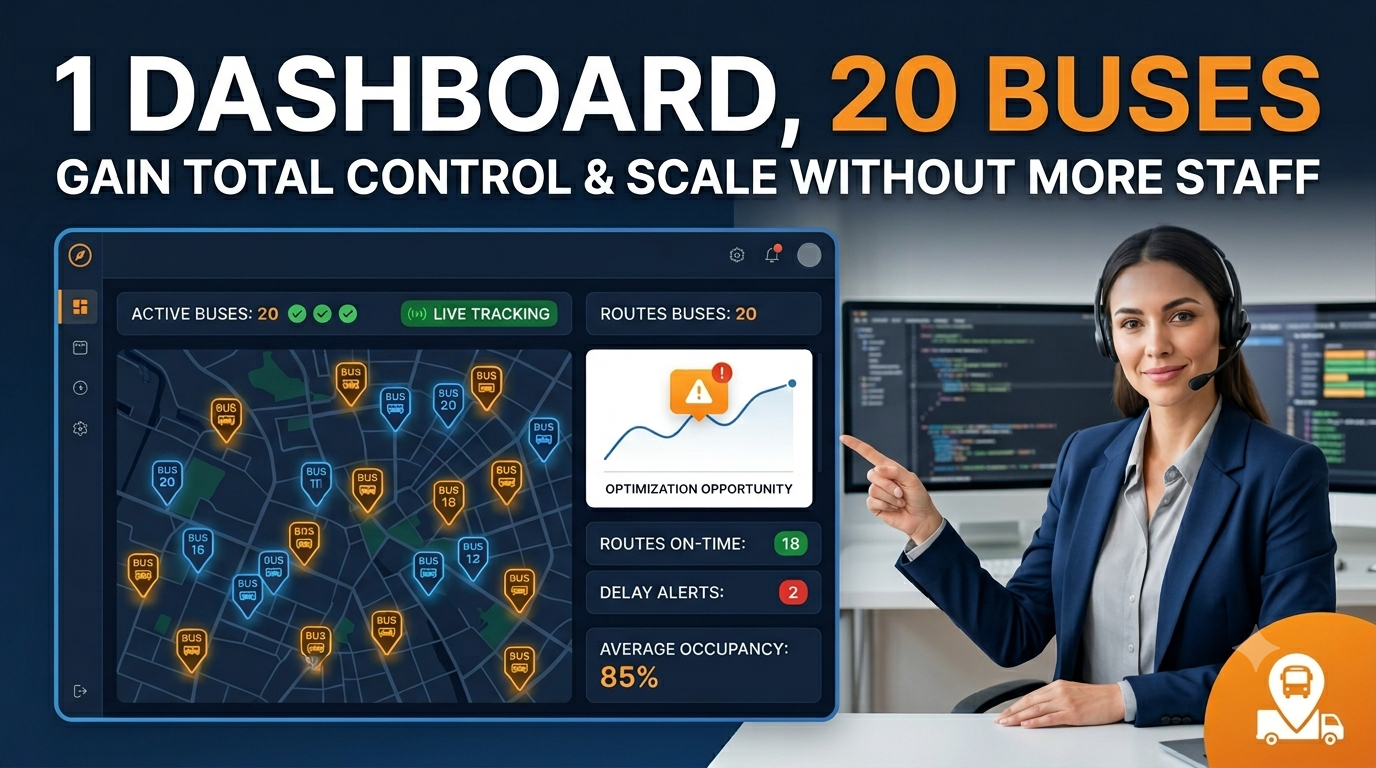
Every bus, on one map, updating in real time. Not a check-in log. Not a driver's self-reported ETA. Actual position data — so you know where each vehicle is without making a single call.
VisibilityInstead of watching 20 buses constantly, the system watches them for you and surfaces only what needs attention — a deviation from route, a bus that's fallen behind schedule, a geofence breach. You act; you don't monitor.
EfficiencyKnow which students boarded, at which stop, and at what time. This closes the accountability loop for parents and gives your school a reliable safety record — without manual headcounts or driver call-ins.
SafetyWhen a bus goes off-route — intentionally or not — you know immediately. And over time, route data helps you identify inefficiencies that can reduce fuel costs and shorten travel times without restructuring your fleet.
OptimisationWhen delays happen — and they will — the system can trigger parent alerts automatically via SMS or app, with no manual intervention required. Parents stay informed; your office stays quiet.
CommunicationIndividually, each of these features is useful. Together, they shift your role from reactive firefighter to proactive fleet manager — a fundamentally different way of working that doesn't require more hands, just better information.
Control Doesn't Mean Micromanagement
One concern transport managers raise when moving to a centralised dashboard is whether it changes the dynamic with drivers — whether it feels like surveillance rather than support.
The answer depends entirely on how you frame it. A dashboard that flags exceptions is not the same as a dashboard that watches every second. The goal isn't to monitor your drivers more closely. It's to reduce the number of times you need to call them, to give them better route information, and to remove the administrative overhead that slows everyone down.
Done well, centralised visibility is a trust-builder — for your drivers, your parents, and your school leadership. Everyone gets the information they need without having to chase it.
Is Your Fleet Ready? A Decision Checklist
Before evaluating any transport management platform, use this checklist to assess where your current system stands — and where the gaps are largest.
If most of those boxes are empty, you're not alone — and you're not behind. But you are running a fleet on instinct when you could be running it on data. That's the shift a unified dashboard makes possible.
Scaling Without Stretching Your Team
The question at the heart of this topic isn't really about dashboards or GPS or automation. It's about what a well-run transport operation actually looks like — and whether your current setup can grow into it.
Adding buses without adding visibility creates risk. Adding visibility without removing manual processes creates more work. The schools winning on transport right now are the ones that have both: a system that sees everything, and a team that only needs to act on what matters.
That's the promise of one dashboard, 20 buses — and it's more achievable than most transport managers think.
Frequently Asked Questions
See your entire fleet on one screen — live
MyTripzo gives transport managers real-time GPS tracking, automated parent alerts, student boarding logs, and route deviation monitoring — all from a single dashboard built for school fleets.
Book a Free Fleet Demo20-minute walkthrough · No commitment · See it live for your fleet size