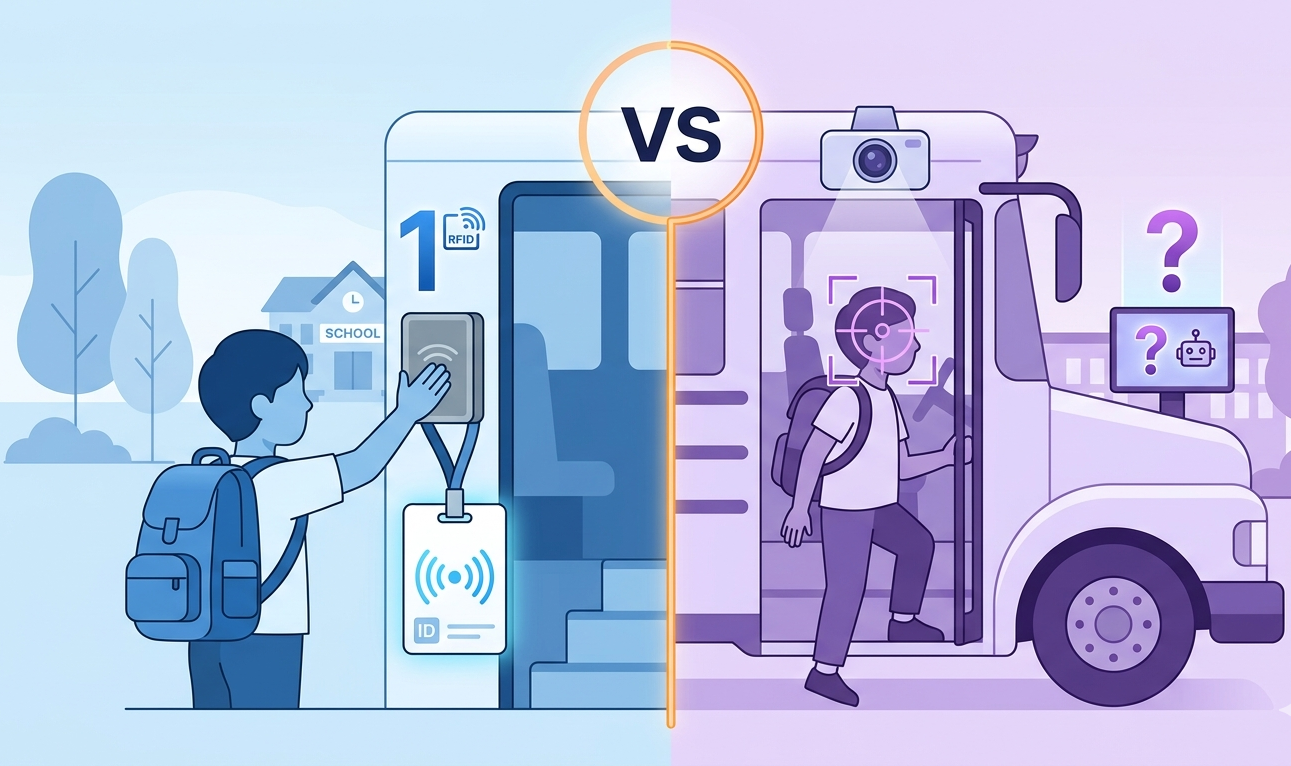
RFID Card / Tag Tap
- ·Child taps a card or wearable at boarding
- ·Attendance logged instantly, parent alerted
- ·Works offline — no camera required
- ·Proven technology, globally deployed
- ·Card can be lost, forgotten, or shared
AI Face Verification
- ·Camera identifies child as they board
- ·No card needed — completely passive
- ·Requires connectivity and camera hardware
- ·Newer technology, adoption accelerating
- ·Raises data privacy questions for minors
School bus attendance is no longer a clipboard job. Both RFID tap systems and AI-powered face verification can automate boarding records, trigger parent notifications, and feed data into a central transport dashboard. The question isn't whether to automate — it's which method fits your school's context, budget, and values.
This post breaks down six dimensions that matter most to school decision-makers, presents them side by side, and leaves the verdict where it belongs: with your leadership team.
Side-by-Side Comparison
Six dimensions, no favourites. Every row is based on how each technology currently performs in real school transport environments.
DimensionRFID TapAI Face Verification
AccuracyHighNear-100% when card is present. Failure mode is a missing or wrong card — not a system error.
High (with caveats)95–99% in controlled conditions. Accuracy drops with poor lighting, masks, twins, or significant appearance changes.
Hardware CostLowerRFID readers are inexpensive; cards and tags are a recurring but manageable cost. ROI achieved quickly at scale.
HigherCamera units, edge computing hardware, and model licensing increase upfront investment significantly.
Boarding SpeedModerateRequires a deliberate tap. Can slow boarding if children fumble with cards or bags.
FasterPassive recognition — child boards normally. No physical action required. Higher throughput per minute.
Ease of Use (Young Children)ModerateYoung children must remember to carry and tap the card. Works best with wearables for younger age groups.
EasierZero action required from the child. Particularly suitable for Reception and primary-age students.
Privacy & DataLower RiskCollects ID and timestamp only. No biometric data. Simpler to comply with child data protection regulations.
Higher RiskFacial data is biometric. Regulations on collecting and storing biometric data for minors vary by region and are tightening globally.
ScalabilityHighStraightforward to roll out across 20, 40, or 100 buses. Adding a route means adding a reader and issuing cards.
ModerateScales well technically, but each bus needs a camera and reliable connectivity. Model retraining needed as student population changes.
A Closer Look at the Dimensions That Divide Schools
Two dimensions consistently generate the most debate in school leadership discussions. Both deserve more than a table cell.
🔒Privacy & biometric data for minors
RFID
Collects a card ID and a timestamp — no more personal than a library system. Data protection obligations are straightforward, and the risk profile for regulatory scrutiny is low.
AI Face Verification
Facial geometry is classified as biometric data under GDPR, COPPA, and similar frameworks. Schools must obtain explicit parental consent, manage secure storage, and stay ahead of evolving regulations on child biometrics.
⚡Boarding speed at peak hours
RFID
A deliberate tap adds 1–2 seconds per child. Across 40 students boarding a single bus, that's a meaningful delay — especially for schools with tight departure windows.
AI Face Verification
Passive recognition happens as the child steps up. No pause, no card search. For large schools with high-volume boarding, this throughput advantage is significant.
💰Total cost of ownership over 3 years
RFID
Lower upfront hardware cost. Ongoing expense is card replacement (lost, damaged) — typically manageable. ROI is achieved within the first academic year for most fleet sizes.
AI Face Verification
Higher hardware and integration cost upfront. Ongoing costs include model updates, connectivity, and compliance management. TCO narrows over time but starts higher.
🧒Experience for young children
RFID
Younger children forget cards. Wearable RFID tags (sewn into bags or worn as bands) reduce this significantly, but it adds a layer of coordination for parents and schools.
AI Face Verification
Zero burden on the child. For nursery and primary-age students especially, the friction-free boarding experience is a genuine operational advantage.
“Neither technology is universally better. The right choice depends on your fleet size, your students' ages, your privacy obligations, and your budget runway.”
Which Method Fits Your School?
Rather than a verdict, here's a clearer way to think about fit. Both methods work. The question is which works better for your specific context.
RFID is likely the better fit if…
Best for
Budget-conscious schoolsPrivacy-cautious leadershipRapid deploymentOlder student cohortsLarge fleet rollouts
Your school needs a proven, cost-effective system that can be deployed quickly across a large fleet. RFID is the established standard in school transport attendance for good reason — it works, it scales, and it doesn't introduce regulatory complexity.
AI face verification is likely the better fit if…
Best for
High-volume boardingYoung / primary-age studentsFuture-forward schoolsStrong IT infrastructureCompliance-ready teams
Your school has the budget, IT capability, and privacy compliance infrastructure to deploy biometric systems responsibly. AI face verification is where school attendance automation is heading — but “heading” and “arrived” are different things.
⚖️Whichever method your school chooses, the underlying transport platform matters as much as the attendance technology itself. Real-time parent alerts, boarding confirmations, and GPS tracking need to work seamlessly with whichever verification method sits at the bus door. The hardware is the input; the platform is what makes it useful.
The Practical Next Step for School Leadership
If your school is still using manual attendance or driver sign-offs for bus boarding, both RFID and AI face verification represent a significant — and worthwhile — upgrade. Start by answering three internal questions:
1
What is our privacy compliance posture for biometric data?
2
What is our realistic budget over three years?
3
What is the average age of our bus-riding student population?
Those three answers will narrow the decision considerably. From there, a live demonstration of each method in a real boarding environment — not a vendor slide deck — is the most useful next step before committing. Platforms like MyTripzo integrate with both RFID and AI face verification systems, feeding attendance data into a single dashboard with real-time parent notifications and boarding confirmations.
Frequently Asked Questions
Can a school use both RFID and AI face verification at the same time?+
Yes — some schools deploy RFID as the primary method and AI verification as a secondary check, particularly for high-risk routes or younger students. The two systems can feed into the same transport dashboard if the underlying platform supports both inputs. However, running both adds cost and operational complexity, so most schools start with one and evaluate later.
What happens when a child forgets their RFID card?+
Most RFID deployments include a fallback procedure — typically a manual check-in logged by the driver or a school staff member at the boarding point. Some platforms send an alert to the transport coordinator when an expected card is not scanned, triggering a manual verification. Schools using RFID wearables (ID bands or tag-embedded bags) see significantly lower card-forgetting rates than card-only deployments.
How does AI face verification handle children who look similar — or twins?+
Modern AI face verification systems are trained to distinguish between closely resembling individuals, including identical twins, using subtle facial geometry differences. However, accuracy in these edge cases is lower than for distinct individuals. Schools with twins or very similar-looking students should confirm accuracy benchmarks with any AI vendor — and have a robust manual fallback in place.
What privacy regulations apply to collecting facial data from children in India?+
India's Digital Personal Data Protection Act 2023 (DPDP Act) classifies data of children under 18 as requiring verifiable parental consent before collection. Biometric data is subject to additional obligations. Schools considering AI face verification should engage a compliance specialist before deployment — the regulatory landscape is active, and guidance from the Data Protection Board of India is still being issued.
Does MyTripzo support both RFID and AI face verification?+
Yes. MyTripzo integrates with both RFID tap systems and AI face verification hardware, feeding boarding confirmations and attendance records into a single dashboard with real-time parent notifications. Whichever method your school chooses, the platform provides the live tracking, alerts, and reporting layer that makes the attendance data useful.
See both methods in action — before you decide
MyTripzo supports both RFID and AI face verification attendance. Book a demo to see how each method feeds into live parent alerts, boarding logs, and your transport dashboard — and ask every question you have before committing.
Book a Free Demo →30-minute session · No commitment · Bring your IT and transport leads