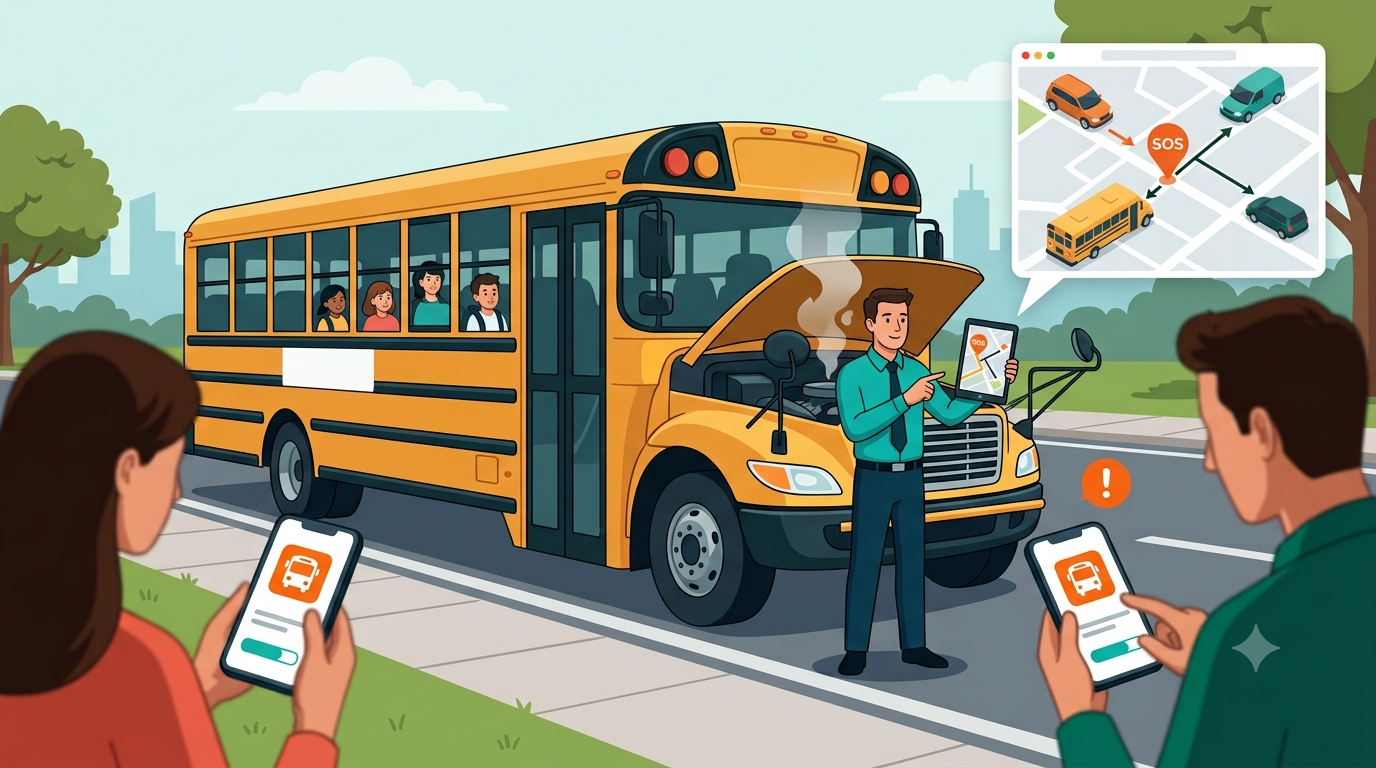
A bus carrying 38 students stalls on the highway shoulder. The driver is calm — she's trained for this. But what happens in the next ten minutes determines whether this becomes a non-event or a crisis: does the school know? Do parents find out from the school, or from a child's phone? Is a backup bus already moving, or is someone still searching for a phone number?
Breakdowns themselves are rarely dangerous. What turns them into a crisis is the absence of a plan — and in 2026, that plan no longer has to rely on phone trees and guesswork.
“A breakdown is a mechanical problem. A bad breakdown response is a communication failure.”
Why Old-Style Breakdown Response Falls Apart
Most schools already have some plan on paper. The problem is that traditional plans were built for a world without live location data — so they lean entirely on people remembering to make calls, in order, under stress.
📍
No one knows where the bus actually isWithout live tracking, "the bus broke down" comes with no location, no ETA for help, and no way to verify the driver's account in real time.
📱
Parents hear it from their kids firstA child's text — "the bus stopped, idk why" — reaches a parent minutes before any official word does. Panic fills that gap fast.
🔄
No backup plan, just improvisationFinding a replacement bus or arranging alternate transport becomes a live scramble instead of a pre-defined next step.
None of this is about driver competence. Drivers are almost always doing the right thing — pulling over safely, keeping students calm, contacting dispatch. The breakdown isn't the failure. The information vacuum afterward is.
The Modern Response: Built Around Real-Time Visibility
A modern incident response plan starts from one principle: every party — school, parent, driver — should be working from the same live information, not separate, delayed versions of the story.
2 min
Target window to notify parents once a breakdown is confirmed
1 view
Single live map all parties can check — no relayed updates
0
Guesswork — GPS location and SOS alert remove the need to ask "where exactly?"
Breakdown Incident Response Protocol — School Transport
1
Driver triggers SOS / breakdown alert (T+0 min)One tap sends the bus's exact GPS location and status to the transport coordinator and admin dashboard simultaneously — no need to first find a phone signal and dial in.
SOS / App alert
2
Coordinator confirms situation (T+1 min)Live location and driver status are already visible — the coordinator's first call to the driver is to check on students, not to ask "where are you?"
Internal step
3
Parents notified instantly (T+2 min)An automated push/SMS goes to every affected parent at once: "Bus Route 7 has a mechanical issue near [location]. Students are safe. Backup transport is being arranged." No relay, no delay.
SMS alertPush notification
4
Backup transport dispatched (T+2–10 min)The nearest available backup bus or vehicle is identified directly from live fleet location — not by calling around to ask who's free.
Fleet view
5
ETA for backup shared with parents (T+10–15 min)A second update gives a concrete arrival estimate for the replacement, so parents know exactly when to expect their child.
SMS alertPush notification
6
All-clear once students are transferred (T+arrival)A final confirmation closes the loop: "All students from Route 7 are safely on board the backup bus." The original bus is logged for maintenance follow-up.
App notification
Who Does What: Three Roles, One Plan
A good incident plan isn't just a list of steps — it's clarity about who owns each part of the response, so nobody is waiting on someone else to act first.
🧑✈️
Drivers- Pull over to the safest available spot first
- Trigger the SOS/breakdown alert immediately
- Keep students calm, seated, and accounted for
- Stay on the bus until backup or help arrives
🏫
Schools & Coordinators- Confirm status via live location, not guesswork
- Trigger parent notifications within minutes
- Identify and dispatch the nearest backup vehicle
- Log the incident for pattern tracking and maintenance review
👪
Parents- Check the app's live status before calling the school
- Trust the notification timeline — updates are already on the way
- Avoid relaying secondhand info from group chats as fact
- Reach out directly only if no update arrives within the expected window
When each group trusts that the others are doing their part, the entire response moves faster — and calmer. Calm is contagious, and so is panic. The plan's real job is making sure calm wins.
5 Things Every School Should Have Ready Before the Next Breakdown
Breakdown-Readiness Checklist
A live tracking system — so location is never something staff have to ask the driver to describe. A one-tap SOS option for drivers — removing the need to dial in manually under stress. Pre-approved parent notification templates — so the first message goes out in seconds, not after someone drafts one from scratch. A known backup vehicle or buddy-route plan — decided in advance, not figured out live. A simple incident log — tracking what happened, when, and how it was resolved, for accountability and maintenance planning.
The Real Goal: Make Breakdowns Boring
No transport system can promise zero breakdowns — mechanical issues are a fact of running any fleet. What schools can control is how the next ten minutes after a breakdown unfold. Done well, parents barely feel the disruption. Done poorly, a flat tire turns into the most talked-about event of the school year.
The schools that get this right aren't the ones with newer buses. They're the ones whose plan doesn't depend on someone remembering the right phone number at 7:50 AM.
Frequently Asked Questions
What should a school do first when a bus breaks down?+
The first step is confirming the driver and students are safe and pulled over in a secure location. With a modern system, the driver triggers a one-tap SOS alert that shares exact GPS location and status instantly, so the transport coordinator can skip straight to checking on students rather than asking where the bus is.
How quickly should parents be notified after a school bus breakdown?+
Within about two minutes of the breakdown being confirmed. An automated push notification or SMS sent to every affected parent at once — stating the issue, that students are safe, and that backup transport is being arranged — prevents parents from hearing about it secondhand from their children first.
How does a school find a backup bus quickly during a breakdown?+
By checking live fleet location rather than calling drivers one by one to ask who is nearby and free. A dashboard showing every bus's real-time position lets a coordinator identify and dispatch the nearest available vehicle within minutes of the initial alert.
What information should a parent notification include during a bus breakdown?+
A good notification names the affected route, gives an approximate location, confirms student safety explicitly, and states that backup transport is being arranged. A follow-up message with a concrete ETA for the replacement bus closes the loop so parents know exactly when to expect their child.
Whose responsibility is it to manage a school bus breakdown — the driver, the school, or the transport provider?+
All three, with clearly divided roles. Drivers are responsible for safety on the ground and triggering the alert. Schools and coordinators own confirmation, parent communication, and dispatching backup transport. Parents play a role too — checking the live app status and trusting the notification timeline instead of escalating prematurely.
Does GPS tracking actually make a bus breakdown safer, or just better communicated?+
Both. Live GPS removes the delay and ambiguity that turns a routine mechanical issue into a stressful event — it verifies the driver's account in real time, tells the coordinator exactly where to send backup, and gives parents a live reference point instead of secondhand updates.
What should schools have ready before their next bus breakdown happens?+
Five things: a live tracking system, a one-tap SOS option for drivers, pre-approved parent notification templates, a known backup vehicle or buddy-route plan, and a simple incident log for accountability and maintenance follow-up. Having these in place before an incident is what keeps the response fast instead of improvised.
How does an incident log help after a school bus breakdown is resolved?+
It creates a record of what happened, when, and how it was resolved — which supports accountability with parents, feeds into maintenance planning if a particular bus breaks down repeatedly, and gives schools a factual basis for any follow-up conversations rather than relying on memory.
See how MyTripzo turns breakdowns into a non-event
Live GPS tracking, one-tap driver SOS alerts, instant parent notifications, and backup dispatch — all from one dashboard built for school transport teams.
Book a Tripzo DemoNo commitment · 20-minute walkthrough · See it live