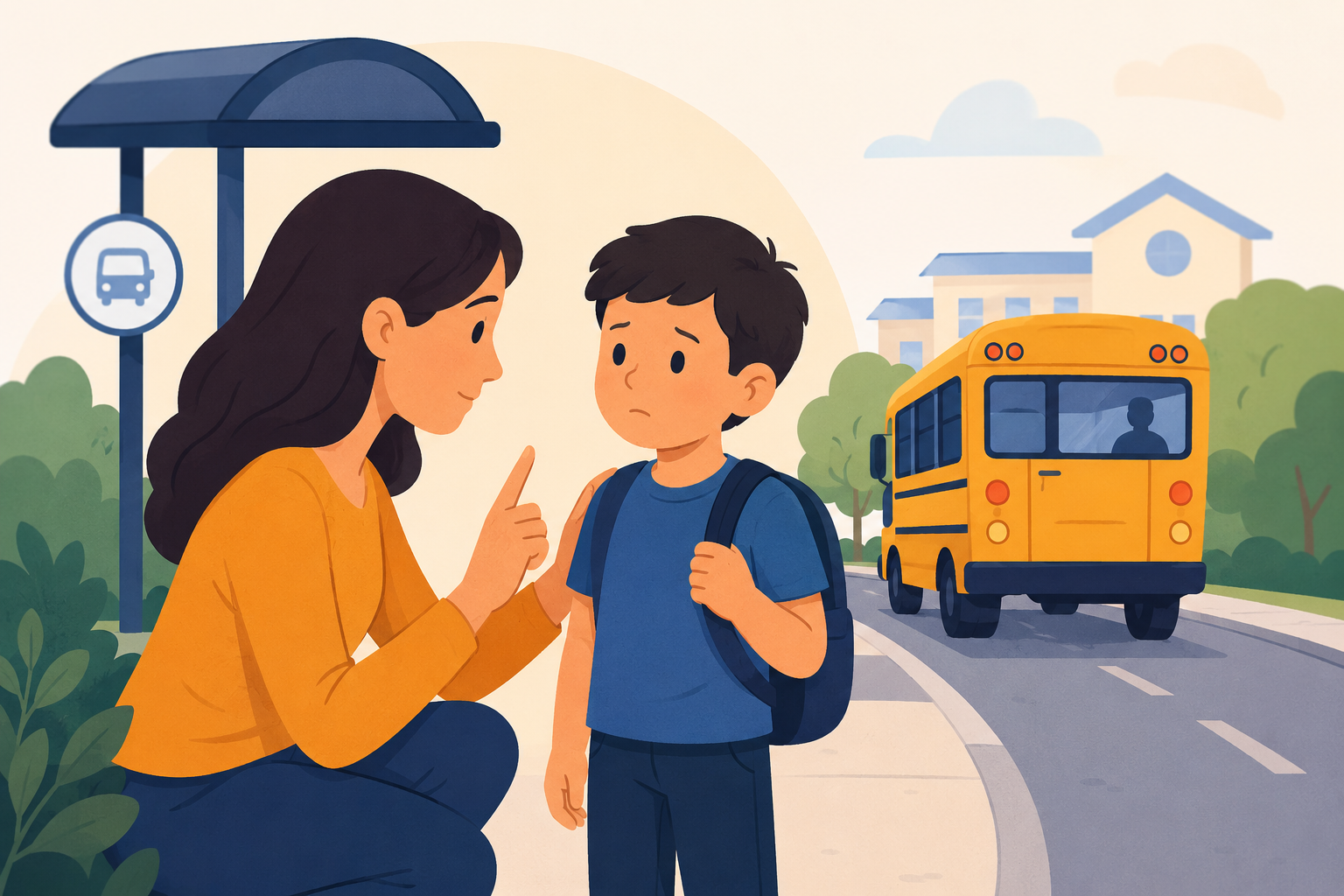
Missing the school bus happens to almost every child at some point. The difference between a scary experience and a manageable one isn't luck — it's preparation. This guide gives you exactly what to put in place before it happens.
You've done the morning routine a hundred times. Bag packed, breakfast eaten, out the door. But what happens the one morning the bus pulls away thirty seconds early — or your child gets to the stop and realises they've missed it?
Most children in that moment have no clear plan. They stand at the stop feeling uncertain, maybe scared, maybe making decisions they haven't been taught to make. The solution isn't stricter morning routines. It's a simple, rehearsed plan — one your child can recall without thinking. Here's how to build that plan, scenario by scenario.
Step 1: The First Two Minutes — Stay or Go Inside?
The most important decision your child faces in the first moments is whether to stay at the stop or go back indoors. Get this one right and everything else becomes calmer.
🏠
If home is within sight or a short walk backGo back inside, tell a trusted adult immediately, and call the school from there. This is almost always the safest first move for younger children. Home is the known quantity — use it. Make sure your child knows: going back home is not failure. It's exactly the right thing to do.
🏫
If the stop is at a school gate or supervised locationStay put and find a trusted adult on site — a security guard, a school staff member, a shopkeeper the family knows by name. The rule: don't move further away from a known, safe location.
⚠️
If the stop is an unfamiliar or isolated areaStay visible, stay still, and call immediately. Moving around in an unfamiliar area makes it harder for a parent or school to locate the child. The instruction here: plant your feet and pick up the phone.
Step 2: Who to Call — And in What Order
Give your child a clear, numbered call list. Not a general “call me” — a specific order they can follow even if they're flustered. Practice it until it's automatic.
1
Parent / guardian — mobile numberThe first call, always. Save it in the phone as "Call First" so there's no searching under stress.
First2
Second parent, relative, or trusted neighbourSomeone local who can reach the child quickly if the first call goes unanswered. This person should know they're on the list.
Second3
School transport office or main receptionThe school should always be looped in. They can hold a teacher at the gate, note the absence from the bus, and support parent communication.
ThirdWrite these numbers somewhere physical too — not just in the phone. A small card in the school bag works well for younger children. If the phone battery dies, the card still works.
Step 3: What NOT to Do
This section matters just as much as the steps above. Children make unsafe decisions in stressful moments not because they're careless — but because no one told them clearly what to avoid.
✓ Safe choices
- ✓Stay in one place until someone comes
- ✓Call from the spot — don't walk and call
- ✓Go to a known adult nearby (school staff, security guard, a familiar shopkeeper)
- ✓Tell a trusted adult what happened, even if embarrassed
- ✓Stay on the phone until someone is on their way
✗ Avoid these
- ✗Never accept a ride from anyone not on the call list
- ✗Don't wander toward school on foot alone
- ✗Don't assume someone will notice and fix it
- ✗Don't hide the fact that the bus was missed
- ✗Don't get into a vehicle with someone you've only just met
Step 4: If No One Picks Up the Phone
This is the scenario that frightens children most — and parents too. Walk your child through it explicitly, because knowing what to do when Plan A fails is what keeps them calm.
📋
Go down the call list, one by oneDon't call the same number three times in a row. If the first person doesn't answer, move to the second, then the third. Each person on the list should be told in advance that they might receive this call — so they know to answer numbers they don't recognise.
🏫
Call the school directlyThe school office is always a safe option. They can contact parents on the child's behalf, let teachers know the situation, and provide calm guidance over the phone while your child waits. Make sure your child has the school number saved — or written on that bag card.
🚪
Find a trusted adult nearbyIf the stop is near a shop, a community space, or a school gate, a responsible adult there can help make contact. Teach your child to ask: "I've missed my school bus. Can you help me call my mum/dad?" — a clear, specific request is easier than a vague "I need help."
Step 5: How to Stay Calm While Waiting
📍
Stay exactly where you areSomeone is coming to you. Moving makes it harder to find you.
📱
Keep your phone accessibleDon't put it away. Leave the ringer on. They'll call back.
💡
Stay visibleStand in an open, well-lit spot — not behind a wall or in a quiet corner.
🧡
You are not in troubleMissing a bus is not a mistake. A plan is already in motion.
That last point deserves emphasis. Children often delay calling because they're afraid of getting in trouble, or embarrassed about what happened. Make it crystal clear at home: calling for help is always the right move, and it will never lead to punishment.
“A child who knows exactly what to do is a child who can stay calm. Calm children make safe decisions.”
The Safety Script: Practise This at Home
Run through this with your child a few times — at dinner, on the weekend, during a calm moment. The goal isn't memorisation; it's familiarity. When a child has said something out loud a few times, it comes back naturally under stress.
If you miss the bus, say this to yourself first:
"I am safe. I know what to do. I'm going to stay here and call."
When you call Mum / Dad / Guardian, say:
"Hi, it's me. I missed the bus. I'm at [stop name / location]. I'm staying put. Can you come or tell me what to do?"
If no one answers, leave this voicemail:
"It's [name]. I missed the bus at [location]. I'm safe. Please call me back. I'm going to call [next person on list] now."
If you need to ask a nearby adult for help, say:
"Excuse me — I've missed my school bus. Could you help me call my parent please? Their number is [number]."
💡 Tip: Write the key numbers on a small card and keep it in the front pocket of the school bag. Phones run out of battery; cards don't.
Schools using a bus tracking platform like MyTripzohave a head start in moments like these. When a child doesn't board the bus at their scheduled stop, parents receive an automatic alert — often before the child has even reached for their phone. The earlier a parent knows, the shorter the wait for the child.If your school isn't using real-time boarding alerts yet, it's worth asking why not.
One Conversation, Lifelong Confidence
You don't need to turn this into a formal safety lesson. Bring it up naturally — in the car, over a meal, on the way to school. Ask your child: “Hey, what would you do if the bus left without you?” Listen to their answer. Fill in the gaps. Run through the script together once.
That's it. One conversation, revisited occasionally as they get older, is enough to give your child a framework they'll carry with them for years. And it gives you something equally valuable: the quiet confidence that if it ever happens, they'll know exactly what to do.
Frequently Asked Questions
What is the single most important thing my child should do if they miss the school bus?+
Stay in one safe, visible place and call a trusted adult from the pre-agreed call list — in that order. Moving away from a known location makes it harder for a parent, relative, or school staff member to find them quickly. The plan should always start with "stay put, then call," not "figure it out and walk toward school."
Should my child go back home or wait at the bus stop if they miss the bus?+
It depends on the location. If home is close by or within sight, going straight back inside and telling a trusted adult is usually the safest first move, especially for younger children. If the stop is at a school gate or another supervised location, staying put and finding a known adult on site is better. If the stop is unfamiliar or isolated, the child should stay visible, stay still, and call immediately rather than walk anywhere.
How many people should be on my child's emergency call list?+
Three is a good working number: the primary parent or guardian first, a second parent, relative, or trusted neighbour who lives nearby second, and the school transport office or main reception third. Save the numbers in the child's phone with clear labels like "Call First," and also write them on a small card kept in the school bag in case the phone is unavailable.
What should my child do if no one answers their calls?+
Go down the call list in order rather than redialling the same number repeatedly — try the first contact, then the second, then the third. Each person on the list should know in advance that they might get this call, so they answer even from an unfamiliar number. If no one on the list picks up, the school transport office is always a safe next call, and a known adult nearby (school staff, a security guard, a familiar shopkeeper) can help place the call.
How do I stop my child from panicking if this actually happens?+
Rehearsal, not warnings, is what keeps children calm. Practising a short, specific script together at home — what to say to yourself, what to say on the phone, what to say to a nearby adult — means the words come back automatically under stress instead of needing to be invented in the moment. Just as important: tell your child clearly and repeatedly that missing the bus is not a mistake and will never lead to punishment. Fear of getting in trouble is one of the biggest reasons children delay calling for help.
Is it safe for my child to accept a ride from someone they recognise but who isn't on the call list?+
No. The rule should be absolute and simple: only get into a vehicle with someone explicitly on the call list. Recognising a face is not the same as that person being an approved contact. This is one of the few rules in the plan that should have zero exceptions, and it is worth repeating separately from the rest of the conversation so it stands out.
Does real-time school bus tracking actually help in a missed-bus situation?+
Yes — schools using a platform like MyTripzo know within seconds when a registered child hasn't boarded at their scheduled stop, and both the parent and school are alerted automatically. That head start matters: the earlier a parent finds out, the shorter the window their child spends waiting alone, and the sooner a plan can be put into action.
At what age should I start having this conversation with my child?+
As soon as a child begins travelling to school independently or with only a group of peers — typically from around age 5 or 6 for supervised stops, and definitely by the time they're walking to or waiting at a stop without an adult present. The conversation should be revisited every year or two, adjusted for the child's growing independence, rather than treated as a one-time talk.
Give Your School the Tools to Know First
MyTripzo notifies parents the moment their child boards — or misses — the school bus. Real-time alerts, live GPS tracking, and instant parent notifications, all in one platform.
Book a Free Demo →No commitment · 30-minute walkthrough · Live Q&A with our team