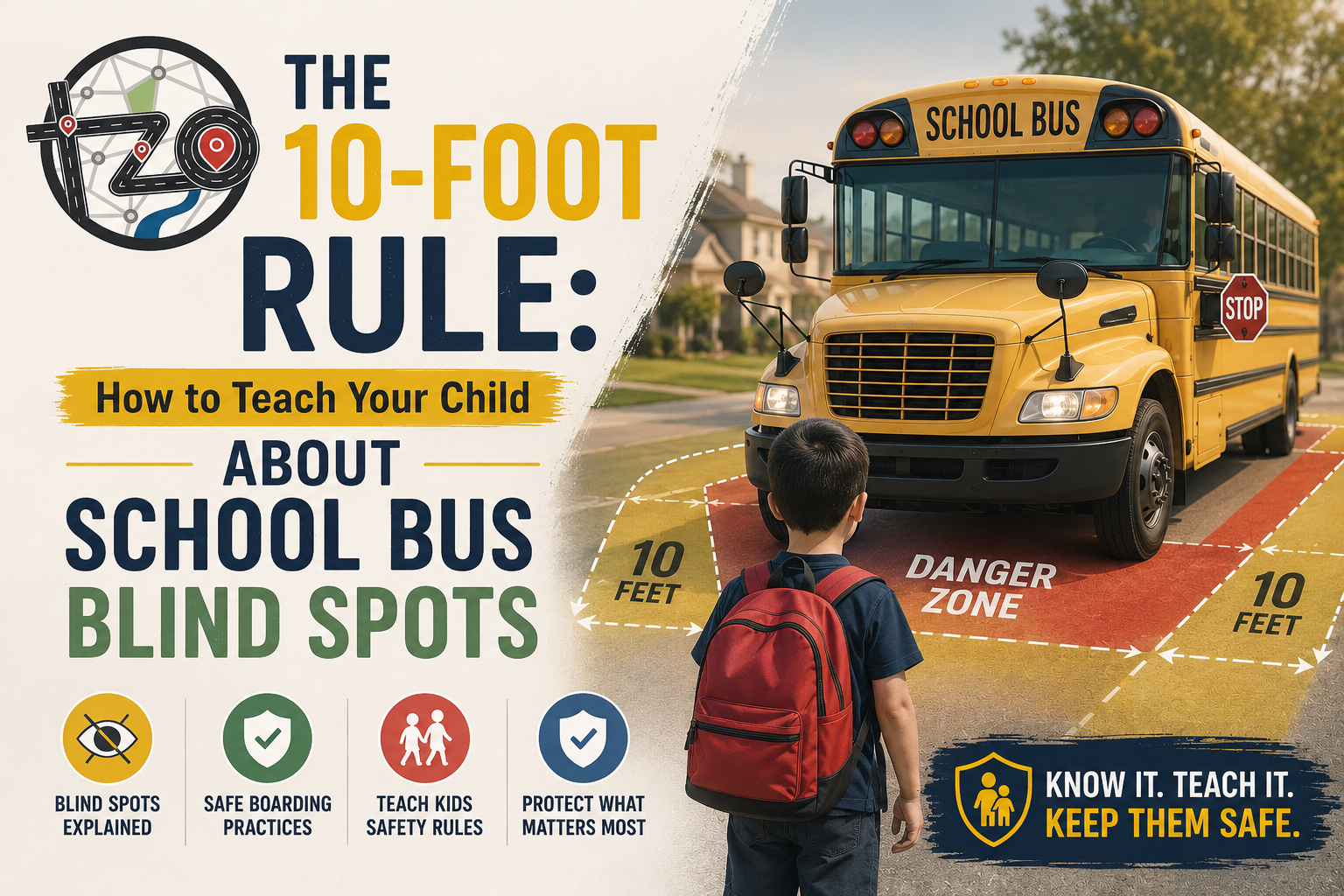
What Is the 10-Foot Rule — and Why Does It Exist?
The 10-Foot Rule is simple: a child should never be closer than 10 feet (roughly 3 big steps) to a school bus unless they are directly boarding or exiting through the door. This distance is not arbitrary — it represents the outer edge of the bus's most dangerous blind spot zone, directly in front of the bumper.
The driver sits high up in the cab. From that position, the area immediately in front of the bus — stretching up to 10 feet forward — is completely invisible to them. A child crouching to pick something up, tying a shoelace, or simply standing too close can be entirely out of the driver's sight.
All 4 School Bus Blind Spot Zones — Mapped and Explained
A school bus has four distinct blind spot zones. Understanding each one — and teaching your child which is most dangerous — is the foundation of real bus safety.
Extends up to 10 feet directly in front of the bus bumper. The driver's elevated seat position makes this zone completely invisible. This is why the 10-Foot Rule specifically targets this zone.
📌 Rule: Always walk at least 10 feet in front before crossing. Make eye contact with the driver first.
Runs along the entire left side of the bus, approximately 3 feet wide. Children who stand too close to the side — especially near the rear wheels — are invisible to the driver's mirror.
📌 Rule: Stay at least one arm's length away from the entire side of the bus while waiting.
The right side has a larger blind spot than the left because the driver sits on the left. This zone is widest near the rear and can extend up to 15 feet outward in some bus configurations.
📌 Rule: Never walk along the right side of the bus. Always cross using the designated front crossing path.
Extends approximately 50–65 feet behind the bus. Children playing or waiting behind a stationary bus — or chasing a ball that rolls behind it — enter a zone where the driver has no rear visibility whatsoever.
📌 Rule: Never walk behind a bus. If a ball or bag goes behind the bus, always tell an adult first.
Safe Boarding and Exit Procedures — Step by Step
Most children are involved in bus-related incidents not while riding the bus, but during the few minutes of boarding and exiting. These are the highest-risk moments of the entire journey — and the most preventable.
Boarding the bus safely:
Wait at least 10 feet back from the kerb. Running to catch a bus that is already moving is one of the most dangerous situations a child can be in.
The bus must be fully stationary and the door open before any movement toward it. Children should form a single-file line and approach only when signalled.
The steps are a common trip point, especially with school bags. Always use the handrail. Never jump from the last step.
Exiting the bus safely:
Children should remain seated until the bus has fully stopped and the driver gives the signal. Standing while the bus is slowing down causes falls in the aisle.
After stepping off, walk forward along the side of the bus until you can see the driver's face through the windshield. If you can see them, they can see you. Then wait for their signal to cross.
The driver can only control the bus. They cannot control other vehicles. Teach children to look both ways independently before every crossing, regardless of signals.
What to Do If Something Gets Dropped Near the Bus
This is one of the most important — and most overlooked — scenarios in bus safety. A child drops a water bottle, a shoe falls off, a bag slips. The instinct is immediate: crouch down and pick it up. But if that item has rolled under or near the bus, that instinct can be dangerous.
“If something falls near the bus — stop. Never bend down. Never reach under. Walk to a safe distance and tell the bus driver or another adult. Things can be replaced. You cannot.”
Practice this scenario at home. Role-play dropping a ball near an imaginary bus. Ask your child: “What do you do?” Repeat until the answer is automatic. Children who have rehearsed safety scenarios respond far more calmly when the real moment happens.
How Parents Can Teach Bus Safety Rules at Home
Rules taught once are quickly forgotten. Rules practiced at home — and revisited before a new school year — become habits. Here are the most effective ways parents report teaching bus safety to young children.
Use a chair or a box as the "bus." Walk through the full routine — waiting at distance, approaching the door, stepping off, walking 10 feet, checking for the driver's signal, crossing. Make it a game.
In your driveway or garden, physically walk 10 feet with your child and mark it. "This is how far you must always be." Making it physical and visual is far more memorable than just saying "10 feet."
Ask "What if?" questions at dinner: "What if your water bottle rolled behind the bus?" Listen to their answer, gently correct if needed, and praise the right response. Conversational learning sticks longer.
Print the 5-point safety summary below and put it where your child sees it every morning before leaving for school. A visual reminder reviewed briefly each morning builds the habit faster than any one-time lecture.
How School Bus Tracking Software Adds a Layer of Safety
Teaching children the rules is the most important safety step — nothing replaces that. But in 2026, schools and parents have access to technology that provides an additional layer of real-time awareness that simply wasn't available a decade ago.
School bus tracking software gives parents live GPS visibility of their child's bus — so they know exactly when the bus is 5 minutes away, when it has arrived at the stop, and when their child has boarded. This matters for bus safety because:
When parents can see the bus is still 12 minutes away, children can wait safely indoors rather than standing exposed at a kerbside stop in traffic.
Boarding and exit notifications give parents real-time confirmation that their child is on the bus — and that they arrived at their stop. No anxious calls. No uncertainty.
Transport coordinators see every bus in real time, receive alerts for delays, and can communicate with drivers instantly — reducing the chaos of missed stops or route changes.
A parent who arrives at the stop precisely when the bus arrives removes the need for their child to wait alone at the kerb. MyTripzo makes this possible for any parent with a phone.
Parent–Child Safety Summary
Print this and put it where your child sees it every morning before school 🖨️
Frequently Asked Questions
Give Every Parent Real-Time Peace of Mind at Every Stop
See how MyTripzo helps schools and parents stay informed, connected, and confident — from the moment a child boards to the moment they're safely home.
Book a Free Demo →No commitment · 30-minute walkthrough · Live Q&A with our team