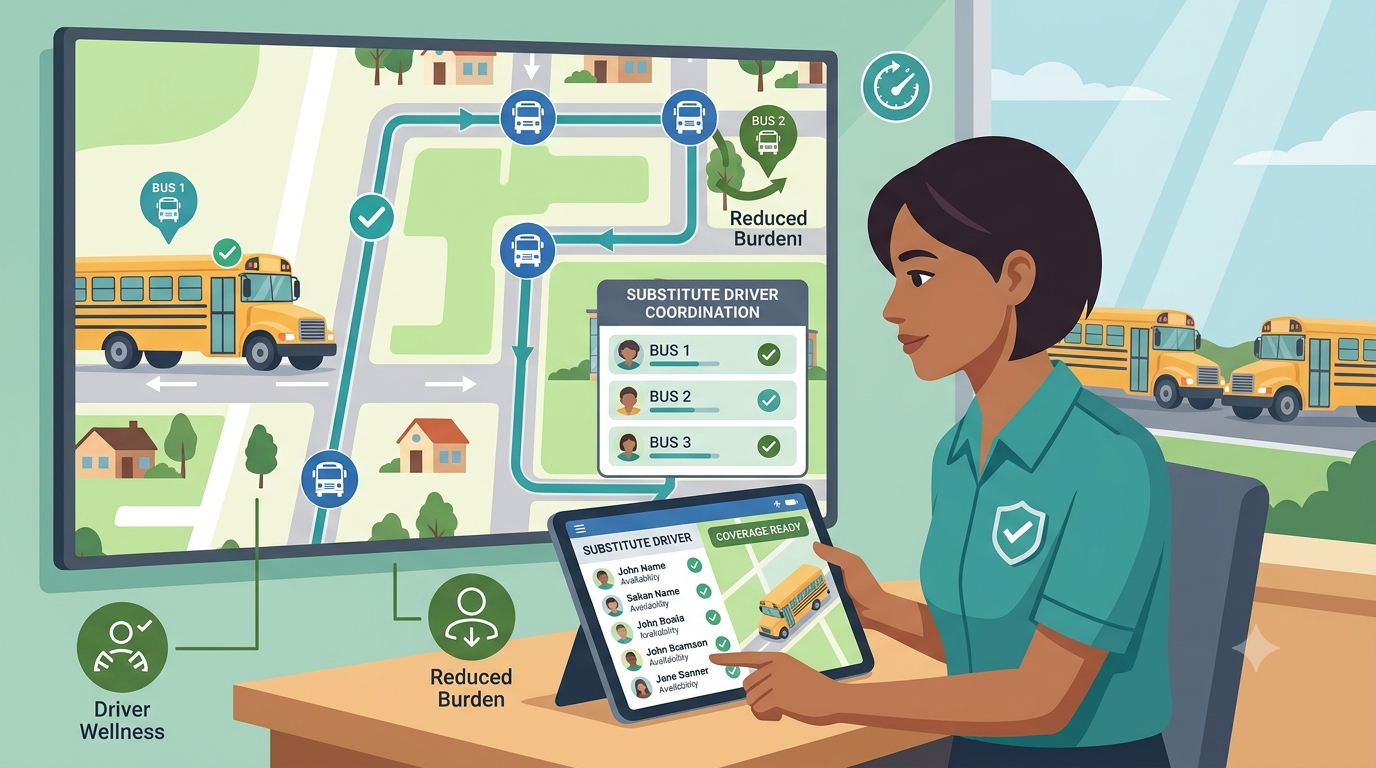
Driver shortages have been a persistent reality across school transport for years now — an aging driver workforce, demanding split shifts, and competition from other industries have all combined to make qualified drivers harder to find and keep. Most transport coordinators don't need that explained to them. What they need is a way to keep routes running well with the drivers they actually have.
The honest truth is that technology won't conjure up more drivers. What it does is change what's required to run a route well, so fewer drivers can cover more ground without the system breaking down every time someone calls in sick.
“The shortage isn't solved by finding more drivers. It's managed by needing fewer things to go right for each one you have.”
Two Schools, Same Shortage, Different Outcomes
Two schools can face the identical driver shortage — same regional hiring pool, same number of open positions — and end up in completely different places six months later. The difference isn't luck. It's whether the systems around their drivers help or hinder.
Reactive School
- A driver calling in sick triggers a scramble to find coverage, often too late
- Drivers juggle radio calls, paper logs, and parent questions on top of driving
- Remaining drivers absorb extra routes ad hoc, with no visibility into who's overloaded
- Burned-out drivers leave, making the shortage worse over time
Adaptive School
- A driver calling in sick triggers an immediate view of who's available to cover
- Drivers focus on driving — communication and logging happen with minimal manual input
- Route load is visible across the whole fleet, so coverage is balanced, not improvised
- A less stressful job becomes a reason drivers stay, easing the shortage gradually
Notice that neither school has more drivers than the other. The adaptive school simply needs less from each one — less manual coordination, less stress, less guesswork when something changes at the last minute.
Four Ways Technology Eases the Shortage
1
Doing more with fewer drivers
When routes are visible together rather than planned one at a time, overlap and inefficiency that quietly waste driver-hours become obvious — and fixable. The same number of drivers ends up covering more students without anyone driving longer.
Route efficiency2
Making the job itself lighter
A driver's day gets harder every time they're expected to also be a dispatcher, a customer service line, and a record-keeper. Automating notifications, check-ins, and logging lets drivers focus on the one job that actually requires their full attention: driving safely.
Reduced burden3
Reacting faster when someone calls out
A driver shortage turns every single absence into a crisis if there's no fast way to see who's free and reassign a route. Real-time visibility into driver and vehicle availability turns "who can cover Route 9 this morning" from a string of phone calls into a quick lookup.
Faster coverage4
Helping drivers stay, not just cope
Retention is the quiet half of the shortage problem — every driver who leaves makes hiring harder. Tools that reduce daily friction and stress directly affect whether a driver sticks around for another year or decides the job isn't worth it anymore.
Retention4 Levers
Distinct ways technology eases a driver shortage — without a single new hire
5 Questions
A self-check any transport coordinator can run on their own workflow today
Same Fleet
Two schools facing an identical shortage can end up in very different places
Why This Matters More Than It Looks Like It Should
It's tempting to treat the driver shortage as purely a hiring problem — something HR and recruiting need to solve. But every driver who quits because the job became unsustainable adds to the same shortage that hiring is trying to fix. Retention and recruiting aren't separate problems; they're the same problem viewed from two directions.
Schools that reduce daily friction for their current drivers aren't just coping better today — they're slowing the rate at which the shortage gets worse tomorrow.
5 Questions to Ask About Your Own Driver Workflow
Driver Workflow Self-Check
When a driver calls in sick, how long does it take to know who's available to cover? How much of a driver's day is spent on calls, texts, and manual logs instead of driving? Is route load visible across the whole fleet, or only known route-by-route? Do your most experienced drivers describe the job as manageable, or as something they're enduring? Has anyone left in the past year citing stress or workload rather than pay alone?
The Shortage Isn't Going Away Soon — So the Systems Have To Adapt
There's no single fix that makes a driver shortage disappear. What's within a school's control is whether the systems around its drivers make the job sustainable or make it harder than it needs to be. Every bit of friction removed from a driver's day is one more reason they stay — and one less route that needs scrambling to cover.
The schools managing this well aren't waiting for the hiring market to improve. They're making sure that whoever is behind the wheel today has a system that supports them, not one that quietly pushes them toward the door.
Frequently Asked Questions
What is causing the school bus driver shortage?+
The shortage stems from a combination of factors that have built up over years — an aging driver workforce, demanding split shifts that don't suit many workers' schedules, and steady competition from other industries offering more predictable hours. It isn't caused by any single factor, which is why it hasn't been solved by any single fix either.
Can technology actually solve a school bus driver shortage?+
Not on its own — technology can't conjure up more drivers. What it does is change what's required to run a route well, so fewer drivers can cover more ground without the system breaking down every time someone calls in sick. It manages the shortage rather than eliminating it.
How does real-time fleet visibility help during a driver shortage?+
When routes and driver availability are visible together rather than tracked one at a time, overlap and inefficiency that quietly waste driver-hours become obvious and fixable. It also turns "who can cover this route today" from a string of phone calls into a quick lookup, which matters most in the first chaotic minutes after an absence is reported.
What is the difference between a reactive and an adaptive school when handling driver shortages?+
A reactive school scrambles to find coverage after a driver calls in sick, often too late, and leaves remaining drivers to absorb extra routes ad hoc with no visibility into who's overloaded. An adaptive school gets an immediate view of who's available, keeps route load visible across the whole fleet, and balances coverage instead of improvising it — using the same number of drivers as the reactive school.
How does automating driver communication reduce burnout and improve retention?+
A driver's day gets harder every time they're also expected to act as a dispatcher, a customer service line, and a record-keeper on top of driving. Automating notifications, check-ins, and logging removes that layered burden, letting drivers focus on driving safely — and a less stressful job is one of the strongest reasons a driver stays for another year.
What questions should transport coordinators ask about their own driver workflow?+
Five are worth asking regularly: how long it takes to find coverage after a driver calls in sick, how much of a driver's day goes to calls and manual logs instead of driving, whether route load is visible across the whole fleet, whether experienced drivers describe the job as manageable, and whether anyone has left in the past year citing stress or workload rather than pay alone.
Does reducing driver workload actually improve long-term retention?+
Yes. Retention is the quieter half of the shortage problem, since every driver who leaves makes hiring harder for everyone else. Tools that cut daily friction and stress directly influence whether a driver sticks around, which is why schools that focus on making the job sustainable tend to see the shortage ease gradually rather than worsen.
Why does driver retention matter as much as driver recruiting when addressing a shortage?+
Retention and recruiting aren't separate problems — they're the same problem viewed from two directions. Every driver who quits because the job became unsustainable adds to the exact shortage that hiring is trying to solve, so schools that reduce daily friction for current drivers are also slowing how fast the shortage gets worse.
Give your drivers a system that makes the job easier
Real-time fleet visibility, automated communication, and faster coverage when plans change — MyTripzo helps schools do more with the drivers they already have.
Book a Tripzo DemoNo commitment · 20-minute walkthrough · See it live