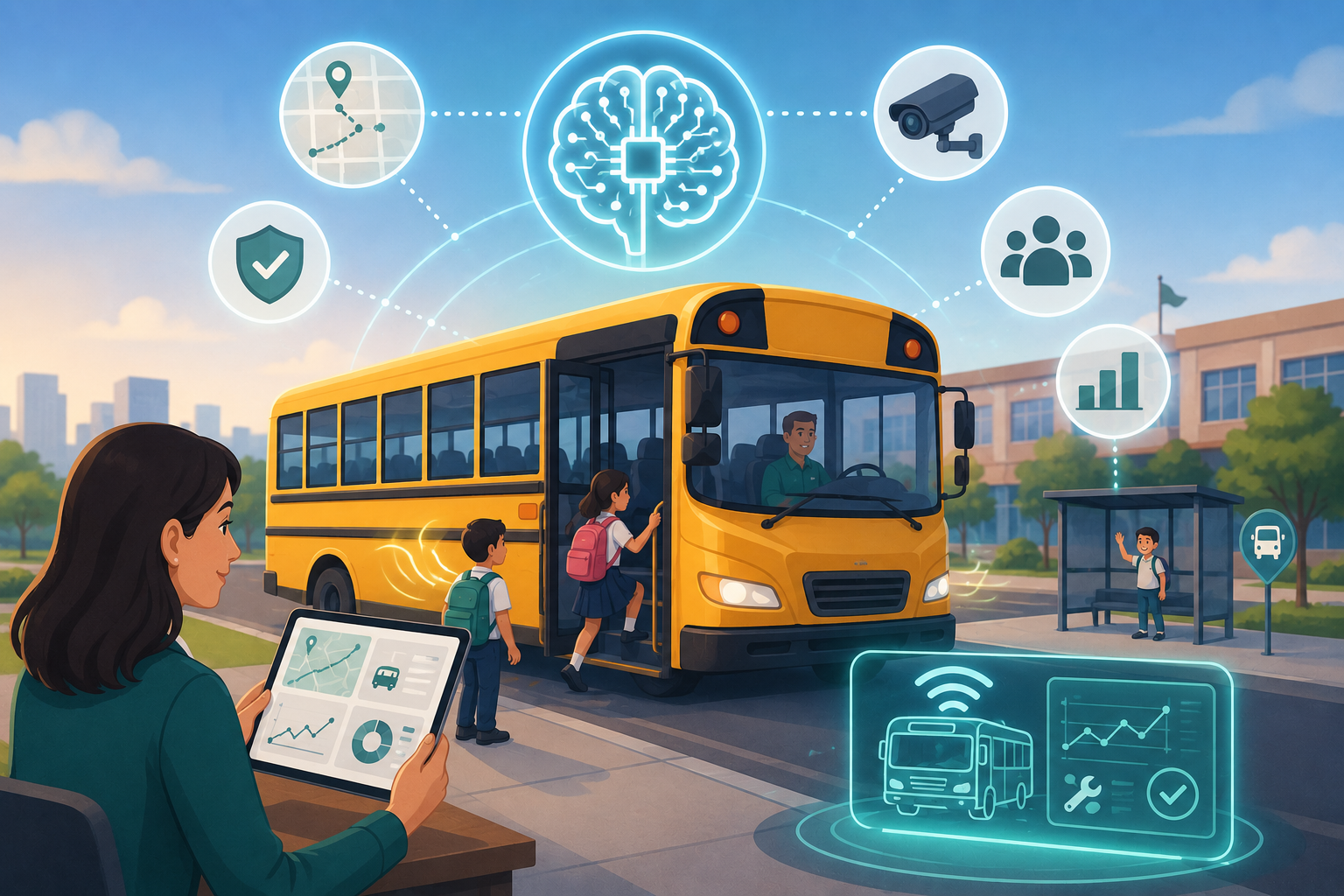
When people hear “AI in school transportation,” they tend to picture something dramatic — autonomous buses, robots replacing drivers, a future that feels far away and a little uneasy. That version of the future isn't what's actually arriving in the next few years.
What's arriving is less cinematic and far more useful: AI quietly improving the systems schools already run — catching problems earlier, communicating faster, and removing the guesswork that's always made school transport harder than it needs to be.
“The future of school transport isn't a new kind of bus. It's a much better-informed version of the one already on the road.”
Why Safety Has to Anchor This Conversation
Any technology applied to school transport earns its place by one measure first: does it make the commute safer, not just smoother. A faster ETA calculation is only worth having if it doesn't come at the cost of vigilance, and an automated alert only matters if it gets the right information to the right person in time to act. The shifts below are worth discussing because each one, done well, reduces a specific kind of risk — not because they're new for their own sake.
Four Near-Term Shifts Worth Watching
Predictive maintenance and breakdown prevention
What’s realistic in 1–3 years:
Instead of maintenance schedules based purely on mileage or fixed intervals, vehicle data increasingly flags early warning signs — unusual patterns that precede a mechanical issue — before it becomes a roadside breakdown. This doesn’t eliminate breakdowns, but it shifts more of them from a surprise on the road to something scheduled before it became a problem.
Fewer roadside surprisesAI-assisted route optimization
What’s realistic in 1–3 years:
Route planning is moving from a manual, memory-based exercise to one where overlap, inefficient sequencing, and capacity mismatches are surfaced automatically across an entire fleet, rather than relying on someone noticing route-by-route. Shorter, better-balanced routes mean less time on the road per student and fewer rushed schedules that pressure drivers to make up time.
Shorter, safer routesAutomated, smarter parent communication
What’s realistic in 1–3 years:
Notifications are getting better at knowing what actually matters to a specific parent at a specific moment — a delay alert with a real ETA rather than a generic message, sent the moment a trigger condition is met rather than after someone manually composes it. Parents and schools end up reacting to the same information at the same time, which matters most during an actual disruption.
Faster, relevant alertsDriver safety monitoring
What’s realistic in 1–3 years:
Signals like harsh braking patterns, irregular route timing, or fatigue indicators are increasingly visible to transport coordinators in near real time, rather than surfacing only after an incident has already happened. Used well, this isn’t about surveillance for its own sake — it’s about catching a tired or stressed driving pattern early enough to intervene.
Earlier interventionWorth keeping in perspective
None of this replaces a present, attentive driver or a transport coordinator who knows their routes well. AI tools are most useful when they remove blind spots and manual burden — not when they're treated as a substitute for human judgment in the moments that matter most.
What This Means for Schools Deciding Where to Invest
Schools don't need to chase every emerging capability to benefit from this shift. The near-term value is concentrated in a few clear places: catching mechanical issues before they become breakdowns, making routes more efficient without adding vehicles, getting timely information to parents without manual effort, and giving coordinators visibility into driver patterns they couldn't previously see.
Each of these is achievable now, with systems already capable of supporting them — this isn't a five-year wait for a future technology to mature. The schools that adopt this earliest aren't betting on something unproven; they're simply choosing to use what's already working.
Related reading: The Driver Shortage Challenge: How Technology Helps Schools Manage Transportation Better, and School Bus Route Optimization: Reducing Travel Time Without Adding More Buses.
The Future Is Less Dramatic Than It Sounds — and More Useful Because of It
The most meaningful version of “AI in school transportation” won't announce itself with a press release about a self-driving bus. It will look like fewer roadside breakdowns, routes that make more sense, parents who get answers without asking, and coordinators who catch a problem driver pattern before it becomes an incident report.
That's not a smaller future. It's the one that actually makes commutes safer, one quiet improvement at a time.
Frequently Asked Questions
Built for where school transport is heading
Live tracking, smarter alerts, and fleet-wide visibility — myTripzo is built on the same principles shaping the next few years of school transportation.
Book a Tripzo DemoNo commitment · 20-minute walkthrough · See it live