The Myth: “We need more buses to fix this.”
It's the default answer to almost every transport complaint — long rides, overcrowded stops, routes that run late. But more buses means more drivers, more fuel, more maintenance, and more cost. Most of the time, it also doesn't fix the actual problem.
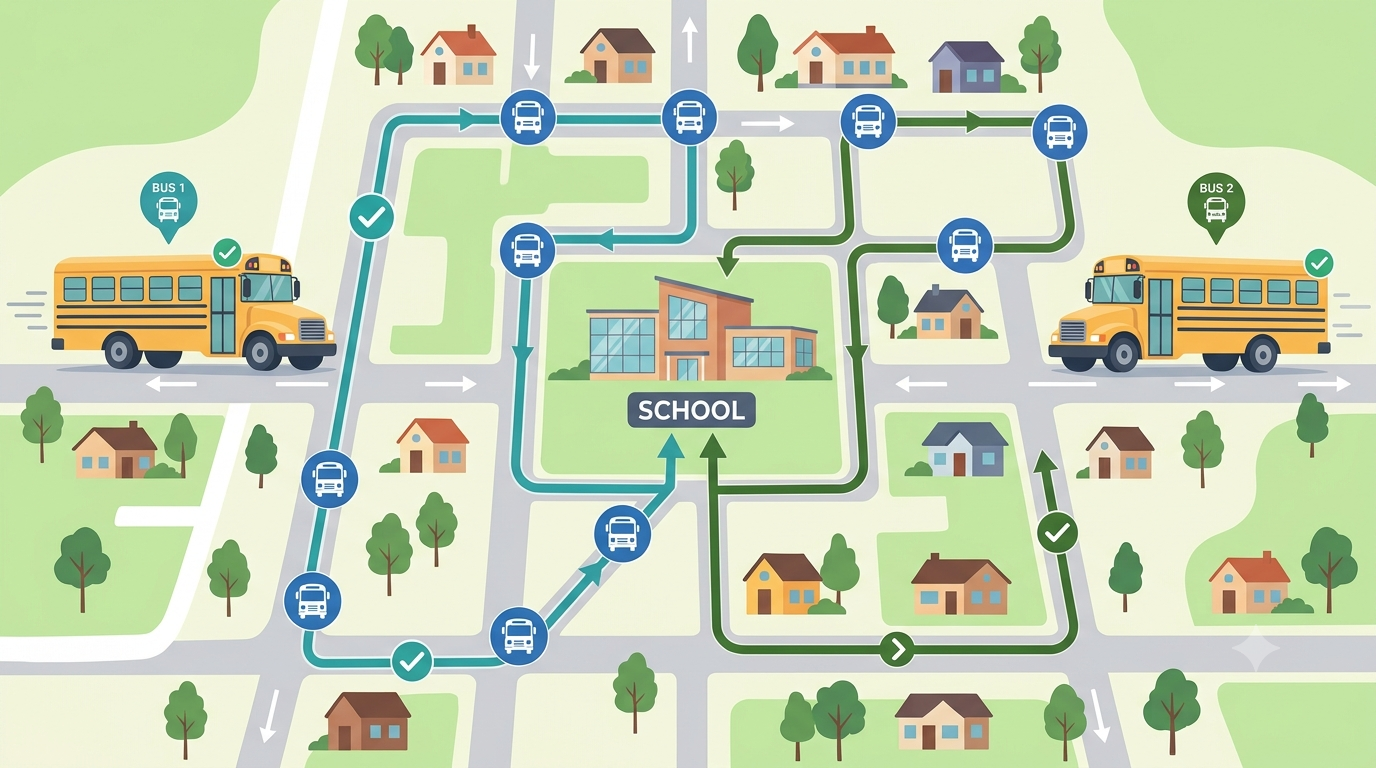
The real issue usually isn't a shortage of buses. It's that the routes those buses run were built once, years ago, and never revisited as the school grew, neighborhoods changed, and stops were added one request at a time. The fleet isn't undersized. It's poorly arranged.
Route optimization fixes the arrangement, not the headcount. Here's what that actually involves.
“A route built three years ago, one stop request at a time, is not a route — it's a history of compromises.”
Why Routes Get Inefficient Without Anyone Deciding That
No one sets out to design a slow route. It happens gradually: a new stop gets added because one family asked, a road closure forces a permanent detour that never gets revisited, and a bus that once carried 30 students now carries 45 because zones got merged. Each change made sense on its own. Together, they add up to routes nobody would design from scratch today.
Optimization isn't a one-time fix bolted onto a broken system — it's the discipline of periodically asking whether the current arrangement still makes sense, using real stop and rider data instead of institutional memory.
Four Levers That Reduce Travel Time — No New Buses Required
Smarter stop sequencing and clustering
Stops added over time are rarely in the most efficient order. Grouping nearby stops and sequencing them along a logical path — rather than the order they were historically requested — cuts unnecessary backtracking and zig-zagging across a neighborhood.
Path efficiencyEliminating route overlap
It's common for two or three buses to independently cover the same stretch of road on their way to different stops. Mapping all routes together — not one at a time — reveals overlap that's invisible when each route is planned in isolation.
Fleet-wide viewRight-sizing capacity to actual ridership
Routes are often sized for a snapshot of demand from years ago. Matching today's bus size and route assignment to today's actual rider counts per stop prevents both overcrowded routes and near-empty ones running the same length.
Capacity matchBalancing pickup time windows
When every route is squeezed into the same tight window, the longest routes inevitably run late. Staggering start times based on route length — rather than treating every route as identical — keeps the longest rides from being the ones most likely to run over.
Schedule balanceNone of these levers require a single additional vehicle. They require treating the route map as something to actively manage, not something that was set once and left alone.
Where Optimization Actually Comes From
The hard part of route optimization has never been the idea — schools have always known overlap and inefficient sequencing exist somewhere in their system. The hard part has been seeing it. Doing this by memory or printed maps means relying on whoever has been around long enough to “just know” the routes, which doesn't scale and doesn't catch what's changed recently.
What's changed is that live stop data, rider counts, and route paths can now be looked at together, fleet-wide, instead of route-by-route from memory. That shift — from intuition to visibility — is what makes optimization practical rather than theoretical.
What Schools Notice When Routes Are Optimized
Students spend less time on the bus simply because the path between stops makes sense again.
No new buses, drivers, or fuel costs — just a rearrangement of the routes already running.
Balanced time windows mean the longest routes aren't structurally set up to fall behind schedule.
5 Signs Your Routes Are Due for a Review
Route Health Checklist
Related reading: The Bus is 20 Minutes Late — Who Should Have Called First?, What Happens When a School Bus Breaks Down? A Modern Incident Response Plan, and The Parent Trust Factor: How Transportation Transparency Improves School Reputation.
Before Buying Another Bus, Look at the Map
Adding a bus is the most expensive way to solve a routing problem — and often the least effective, since a new vehicle dropped onto an already-inefficient map just adds another inefficient route to the pile. Optimization asks a cheaper, more useful question first: is the fleet we have actually arranged well?
For most schools, the honest answer is no — not because anyone made a bad decision, but because no one's looked at the whole picture at once in years. That's usually all it takes to find the time savings everyone assumed required a bigger budget.
Frequently Asked Questions
See your routes the way myTripzo sees them
Fleet-wide route visibility, live stop and rider data, and the overlap your current map can't show you — all in one dashboard built for school transport teams.
Book a Tripzo DemoNo commitment · 20-minute walkthrough · See it live