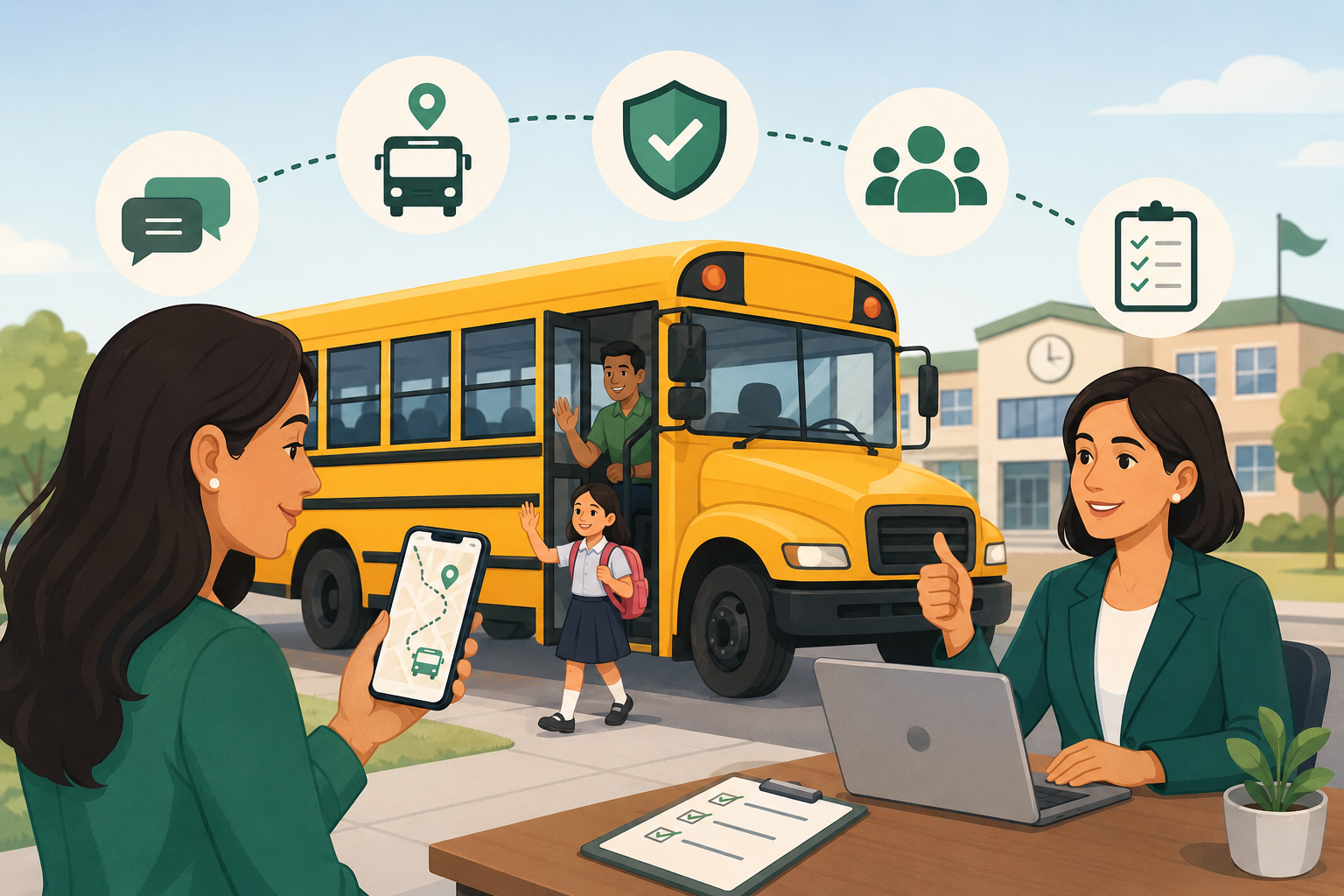
If your transport team fixed every late bus and every breakdown overnight, would the complaints stop?
Most schools assume yes. It feels obvious: fewer problems should mean fewer complaints. But schools that genuinely improve their on-time performance and incident rate often see complaint volume barely move — sometimes it doesn't drop at all.
The Myth: “Fewer incidents will mean fewer complaints.”
This assumes complaints are a direct measurement of how often things go wrong. In practice, complaints measure something else entirely: how it felt when something went wrong, and whether parents had to chase the school to find out.
Complaints aren't a service-quality metric. They're a communication-gap metric. That distinction changes what's actually worth fixing.
“A parent who knew the bus would be late rarely complains about the delay. A parent who didn't know almost always does.”
Five Complaint Categories — and What's Really Driving Each
Complaints tend to cluster into a handful of recurring categories. Each one looks like a different problem on the surface, but most trace back to the same underlying gap: information that should have reached a parent didn't, or arrived too late to matter.
"Where's the bus?" calls
Root cause
Parents have no way to check location themselves, so the only option is calling the school directly — every single time they're unsure.
The fix
Give parents a way to check location on their own. A complaint becomes unnecessary the moment a parent doesn't need to ask the question at all.
Delay and disruption complaints
Root cause
It's rarely the delay itself parents are upset about — it's finding out late, or finding out from their own child instead of the school.
The fix
A fast, proactive heads-up — even a brief one — usually defuses the complaint before it forms. Speed matters more than detail here.
Driver behavior or safety concerns
Root cause
These are often genuine concerns, but they escalate fastest when a parent feels unsure whether the report actually reached anyone or went anywhere.
The fix
A clear, visible way to report a concern and a confirmation that it was received and is being looked into — even before there's a resolution — prevents a single concern from turning into repeated, frustrated follow-ups.
Route and schedule complaints
Root cause
Stop times or route changes that arrive as a surprise feel like the school not thinking about the parent's routine, even when the change was reasonable.
The fix
Advance notice and a brief reason for any change reduce the sense that decisions are happening to parents rather than being communicated to them.
Billing and admin complaints
Root cause
These feel unrelated to safety or timing, but they share the same root: unclear processes that leave parents guessing about what's expected or when something will be resolved.
The fix
Clear timelines and a single place to check status reduce the back-and-forth that turns a simple admin question into a recurring complaint.
It's worth noting briefly: a meaningful share of what gets logged as a “complaint” is really just a parent asking a question they had no other way to get answered. That's not a flaw in the parent — it's a gap in the system. Closing the gap quietly removes complaints that were never really grievances in the first place.
Why Complaint Volume Doesn't Track Incident Rate
Two schools can have nearly the same number of delays and disruptions in a year, yet one logs far fewer complaints. The difference is rarely the incidents themselves — it's whether parents felt informed throughout, or had to chase information at every step.
This is why a school can genuinely improve service and still field the same volume of calls: fixing the underlying problem doesn't fix the experience of not knowing about it in time. Those are two different projects, and most schools only work on one of them.
An Audit Worth Running on Your Own Complaint Log
Before assuming more drivers, newer buses, or stricter schedules will reduce complaints, it's worth checking whether the real pattern is communication, not service quality.
Complaint Categories to Audit
Most schools running this audit for the first time find the same thing: the categories with the highest volume aren't the ones with the worst underlying service. They're the ones with the weakest communication loop.
Related reading: The Parent Trust Factor: How Transportation Transparency Improves School Reputation, and The Bus is 20 Minutes Late — Who Should Have Called First?.
Fix the Gap, Not Just the Incident
Reducing complaints isn't really about eliminating every late bus or every schedule change — some disruption is unavoidable in any transport system. What's avoidable is the part where parents are left to guess, chase, or hear it secondhand.
Close that gap, and complaint volume drops even before the underlying incident rate does. That's the part most schools don't expect, and the part most worth fixing first.
Frequently Asked Questions
Close the communication gap before it becomes a complaint
Live tracking, instant alerts, and a clear trail for every report — myTripzo helps parents get answers before they ever need to call.
Book a Tripzo DemoNo commitment · 20-minute walkthrough · See it live